Retired since 2012.
2394 stories
·
5 followers

“Even the Weather Felt Expensive”

1 Comment

Filmmaker Noah Hawley was invited to Amazon founder Jeff Bezos’s Campfire retreat in 2018. Reflecting on the experience recently for The Atlantic, Hawley writes that today’s super-rich have stopped “pretending that the rules of human society apply” to them.

The Jeff Bezos of 2018 acted as if he still believed that people’s impression of him mattered, that his financial and social value could be affected by negative publicity. He still believed that his actions had consequences. He had not yet freed himself—the way Daniel Plainview freed himself—from the rules of men.

Eight years later, Bezos and two of the world’s other richest men—Mark Zuckerberg and Elon Musk—have clearly left the world of consequences behind. They float in a sensory-deprivation tank the size of the planet, in which their actions are only ever judged by themselves.

The closer I’ve gotten to the world of wealth, the more I understand that being truly rich doesn’t mean amassing enough money to afford superyachts, private jets, or a million acres of land. It means that everything becomes effectively free. Any asset can be acquired but nothing can ever be lost, because for soon-to-be trillionaires, no level of loss could significantly change their global standing or personal power. For them, the word failure has ceased to mean anything.

Daisy Grewal in 2012 for Scientific American: How Wealth Reduces Compassion.

Who is more likely to lie, cheat, and steal—the poor person or the rich one? It’s temping to think that the wealthier you are, the more likely you are to act fairly. After all, if you already have enough for yourself, it’s easier to think about what others may need. But research suggests the opposite is true: as people climb the social ladder, their compassionate feelings towards other people decline.

Billionaire Wilderness: The Ultra-Wealthy and the Remaking of the American West by Justin Farrell sounds like an interesting read along these same lines.

Tags: Daisy Grewal · Jeff Bezos · Noah Hawley · wealth

Read the whole story
cjheinz
2 hours ago
reply
Mme. La Guillotine, s’il vous plait.
Lexington, KY; Naples, FL
Share this story
Delete

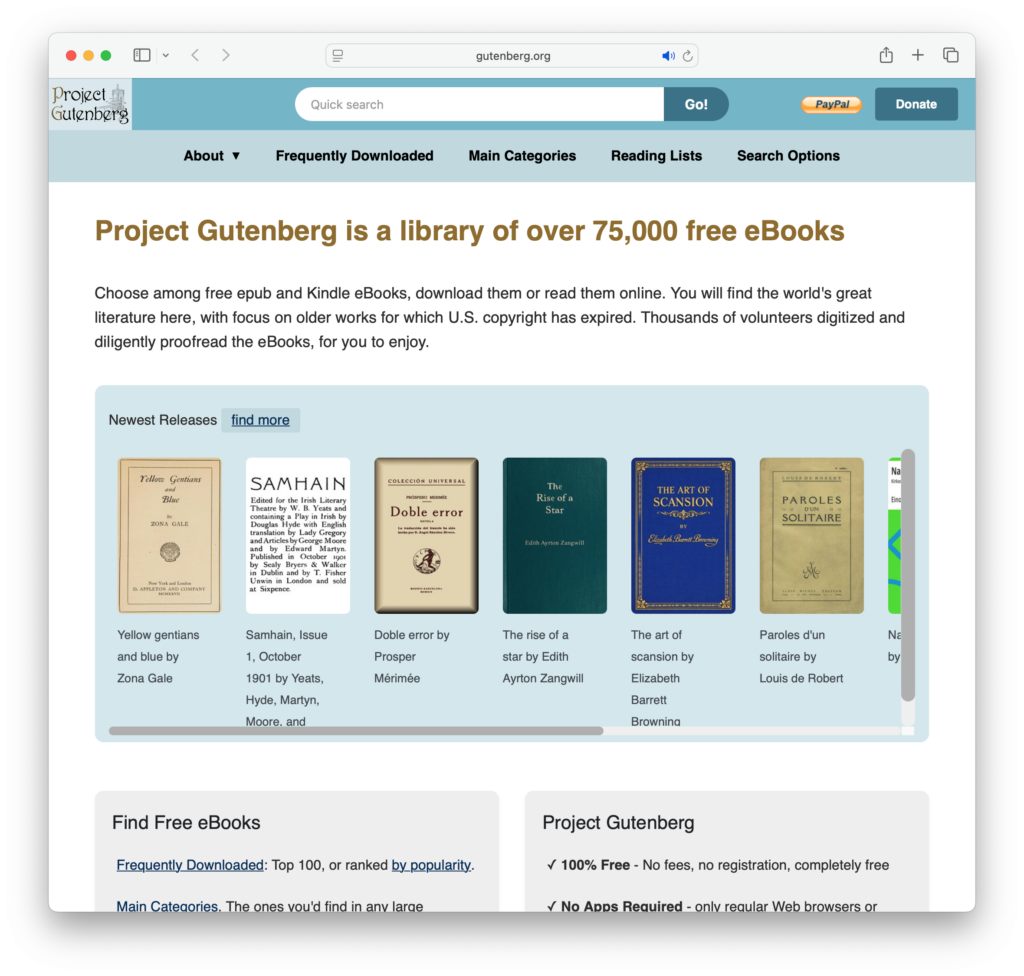
Project Gutenberg

1 Share

Project Gutenberg is one of the oldest and most generous corners of the internet: a vast, free digital library built by volunteers. Founded in 1971, it offers more than 75,000 eBooks—mostly classic works whose copyrights have expired—available to read, download, and share without cost.

Read the whole story
cjheinz
2 hours ago
reply
Lexington, KY; Naples, FL
Share this story
Delete

Subscription Cost Visualizer

1 Comment

Subscription Cost Visualizer is a lightweight, interactive tool that turns your subscriptions into a visual grid. Instead of a list of numbers, you get a clear, proportional view of where your money is going—larger blocks represent higher costs, making your spending instantly legible.

Read the whole story
cjheinz
2 hours ago
reply
Good tool.
Lexington, KY; Naples, FL
Share this story
Delete

Pluralistic: A Pascal's Wager for AI Doomers (16 Apr 2026)

1 Comment and 2 Shares


Today's links


A killer 1940s robot zapping two large domes with eye-lasers; trapped under the domes are two children, taken from 1910s photos of child laborers; one, a little girl in a straw hat, is holding two heavy buckets. The other, a newsie with a shoulder bag, is picking his nose. The background is the collapsing pillars seen in Dore's engraving of The Death of Solomon.

A Pascal's Wager for AI Doomers (permalink)

Lest anyone accuse me of bargaining in bad faith here, let me start with this admission: I don't think AI is intelligent; nor do I think that the current (admittedly impressive) statistical techniques will lead to intelligence. I think worrying about what we'll do if AI becomes intelligent is at best a distraction and at worst a cynical marketing ploy:

https://locusmag.com/feature/cory-doctorow-full-employment/

Now, that said: among some of the "AI doomers," I recognize kindred spirits. I, too, worry about technologies controlled by corporations that have grown so powerful that they defy regulation. I worry about how those technologies are used against us, and about how the corporations that make them are fusing with authoritarian states to create a totalitarian nightmare. I worry that technology is used to spy on and immiserate workers.

I just don't think we need AI to do those things. I think we should already be worried about those things.

Last week, I had a version of this discussion in front of several hundred people at the Bronfman Lecture in Montreal, where I appeared with Astra Taylor and Yoshua Bengio (co-winner of the Turing Prize for his work creating the "deep learning" techniques powering today's AI surge), on a panel moderated by CBC Ideas host Nahlah Ayed:

https://www.eventbrite.ca/e/artificial-intelligence-the-ultimate-disrupter-tickets-1982706623885

It's safe to say that Bengio and I mostly disagree about AI. He's running an initiative called "Lawzero," whose goal is to create an international AI consortium that produces AI as a "digital public good" that is designed to be open, auditable, transparent and safe:

http://lawzero.org

Bengio said he'd started Lawzero because he was convinced that AI was going to get a lot more powerful, and, in the absence of some public-spirited version of AI, we would be subject to all kinds of manipulation and surveillance, and that the resulting chaos would present a civilizational risk.

Now, as I've stated (and as I said onstage) I am not worried about any of this. I am worried about AI, though. I'm worried a fast-talking AI salesman will convince your boss to fire you and replace you with an AI that can't do your job (the salesman will be pushing on an open door, since if there's one thing bosses hate, it's paying workers).

I'm worried that the seven companies that comprise 35% of the S&P 500 are headed for bankruptcy, as soon as someone makes them stop passing around the same $100b IOU while pretending it's in all their bank accounts at once. I'm worried that when that happens, the chatbots that badly do the jobs of the people who were fired because of the AI salesman will go away, and nothing and no one will do those jobs. I'm worried that the chaos caused by vaporizing a third of the stock market will lead to austerity and thence to fascism:

https://pluralistic.net/2026/04/13/always-great/#our-nhs

I worry that the workers who did those jobs will be scattered to the four winds, retrained or "discouraged" or retired, and that the priceless process knowledge they developed over generations will be wiped out and we will have to rebuild it amidst the economic and political chaos of the burst AI bubble:

https://pluralistic.net/2026/04/08/process-knowledge-vs-bosses/#wash-dishes-cut-wood

In short, I worry that AI is the asbestos we're shoveling into our civilization's walls, and our descendants will be digging it out for generations:

https://pluralistic.net/2026/01/06/1000x-liability/#graceful-failure-modes

But Bengio disagrees. He's very smart, and very accomplished, and he's very certain that AI is about to become "superhuman" and do horrible things to us if we don't get a handle on it. Several times at our events, he insisted that the existence of this possibility made it wildly irresponsible not to take measures to mitigate this risk.

Though I didn't say so at the time, this struck me as an AI-inflected version of Pascal's wager:

A rational person should adopt a lifestyle consistent with the existence of God and should strive to believe in God… if God does not exist, the believer incurs only finite losses, potentially sacrificing certain pleasures and luxuries; if God does exist, the believer stands to gain immeasurably, as represented for example by an eternity in Heaven in Abrahamic tradition, while simultaneously avoiding boundless losses associated with an eternity in Hell.

https://en.wikipedia.org/wiki/Pascal%27s_wager

Smarter people than me have been poking holes in Pascal's wager for more than 350 years. But when it comes to this modern Pascal's AI Wager, I have my own objection: how do you know when you've lost?

As of this moment, the human race has lit more than $1.4t on fire to immanentize this eschaton, and it remains stubbornly disimmanentized. How much more do we need to spend before we're certain that god isn't lurking in the word-guessing program? Sam Altman says it'll take another $2-3t – call it six months' worth of all US federal spending. If we do that and we still haven't met god, are we done? Can we call it a day?

Not according to Elon Musk. Musk says we need to deconstruct the solar system and build a Dyson sphere out of all the planets to completely encase the sun, so we can harvest every photon it emits to power our word-guessing programs:

https://www.pcmag.com/news/elons-next-big-swing-dyson-sphere-satellites-that-harness-the-suns-power

So let's say we do that and we still haven't met god – are we done? I don't see why we would be. After all, Musk's contention isn't that our sun emits one eschaton's worth of immanentizing particles. Musk just thinks that we need a lot of these sunbeams to coax god into our plane of existence. If one sun won't do it, perhaps two? Or two hundred? Or two thousand? Once we've committed the entire human species to this god-bothering project to the extent of putting two kilosuns into harness, wouldn't we be nuts to stop there? What if god is lurking in the two thousand and first sun? Making god out of algorithms is like spelling "banana" – easy to start, hard to stop.

But as Bengio and I got into it together on stage at the Montreal Centre, it occurred to me that maybe there was some common ground between us. After all, when someone starts talking about "humane technology" that respects our privacy and works for people rather than their bosses, my ears grow points. Throw in the phrase "international digital public goods" and you've got my undivided attention.

Because there's a sense in which Bengio and I are worried about exactly the same thing. I'm terrified that our planet has been colonized by artificial lifeforms that we constructed, but which have slipped our control. I'm terrified that these lifeforms corrupt our knowledge-creation process, making it impossible for us to know what's true and what isn't. I'm terrified that these lifeforms have conquered our apparatus of state – our legislatures, agencies and courts – and so that these public bodies work against the public and for our colonizing alien overlords.

The difference is, the artificial lifeforms that worry me aren't hypothetical – they're here today, amongst us, endangering the very survival of our species. These artificial lifeforms are called "limited liability corporations" and they are a concrete, imminent risk to the human race:

https://pluralistic.net/2026/04/15/artificial-lifeforms/#moral-consideration

What's more, challenging these artificial lifeforms will require us to build massive, "international, digital public goods": a post-American internet of free/open, auditable, transparent, enshittification-resistant platforms and firmware for every purpose and device currently in service:

https://pluralistic.net/2026/01/01/39c3/#the-new-coalition

And even after we've built that massive, international, digital public good, we'll still face the challenge of migrating all of our systems and loved ones out of the enshitternet of defective, spying, controlling American tech exports:

https://pluralistic.net/2026/01/30/zucksauce/#gandersauce

Every moment that we remain stuck in the enshitternet is a moment of existential risk. At the click of a mouse, Trump could order John Deere to switch off all the tractors in your country:

https://pluralistic.net/2022/05/08/about-those-kill-switched-ukrainian-tractors/

He doesn't need tanks to steal Greenland. He can just shut off Denmark's access to American platforms like Office365, iOS and Android and brick the whole damned country. It would be another Strait of Hormuz, but instead of oil and fertilizer, he'd control the flow of Lego, Ozempic and deliciously strong black licorice:

https://pluralistic.net/2026/01/29/post-american-canada/#ottawa

These aren't risks that could develop in the future. They're the risks we're confronted with today and frankly, they're fucking terrifying.

So here's my side-bet on Pascal's Wager. If you think we need to build "international digital public goods" to head off the future risk of a colonizing, remorseless, malevolent artificial lifeform, then let us agree that the prototype for that project is the "international digital public goods" we need right now to usher in the post-American internet and save ourselves from the colonizing, remorseless, malevolent artificial lifeforms that have already got their blood-funnels jammed down our throats.

Once we defeat those alien invaders, we may find that all the people who are trying to summon the evil god have lost the wherewithal to do so, and your crisis will have been averted. But if that's not the case and the evil god still looms on our horizon, then I will make it my business to help you mobilize the legions of skilled international digital public goods producers who are still flush from their victory over the limited liability corporation, and together, we will fight the evil god you swear is in our future.

I think that's a pretty solid offer.


Hey look at this (permalink)


A shelf of leatherbound history books with a gilt-stamped series title, 'The World's Famous Events.'

Object permanence (permalink)

#25yrsago Every pirate ebook on the internet https://web.archive.org/web/20010724030402/https://citizen513.cjb.net/

#20yrsago Retired generals diss Donald Rumsfeld https://nielsenhayden.com/makinglight/archives/007432.html#007432

#20yrsago How to break HDCP https://blog.citp.princeton.edu/2006/04/14/making-and-breaking-hdcp-handshakes/

#20yrsago How Sun’s “open DRM” dooms them and all they touch https://memex.craphound.com/2006/04/14/how-suns-open-drm-dooms-them-and-all-they-touch/

#20yrsago Benkler's "Wealth of Networks" http://www.congo-education.net/wealth-of-networks/

#15yrsago Scientific management’s unscientific grounding: the Management Myth https://web.archive.org/web/20120823212827/https://www.theatlantic.com/magazine/archive/2006/06/the-management-myth/304883/

#15yrsago 216 “untranslatable” emotional words from non-English languages https://www.drtimlomas.com/lexicography/cm4mi/lexicography#!lexicography/cm4mi

#10yrsago New York public employees union will vote on pulling out of hedge funds https://web.archive.org/web/20160414230326/https://www.bloomberg.com/news/articles/2016-04-13/nyc-pension-weighs-liquidating-1-5-billion-hedge-fund-portfolio

#10yrsago Panama’s public prosecutor says he can’t find any evidence of Mossack-Fonseca’s lawbreaking https://web.archive.org/web/20160419165306/https://www.thejournal.ie/mossack-fonseca-prosecution-2714795-Apr2016/?utm_source=twitter_self

#10yrsago Bernie Sanders responds to CEOs of Verizon and GE: “I welcome their contempt” https://web.archive.org/web/20160415165051/https://www.businessinsider.com/bernie-sanders-verizon-contempt-2016-4

#10yrsago Let’s Encrypt is actually encrypting the whole Web https://www.wired.com/2016/04/scheme-encrypt-entire-web-actually-working/

#10yrsago City of San Francisco tells man he can’t live in wooden box in friend’s living room https://www.theguardian.com/us-news/2016/apr/13/san-francisco-new-home-rented-box-illegal?CMP=tmb_gu

#10yrsago How the UK’s biggest pharmacy chain went from family-run public service to debt-laden hedge-fund disaster https://www.theguardian.com/news/2016/apr/13/how-boots-went-rogue

#10yrsago Ohio newspaper chain owner says his papers don’t publish articles about LGBTQ people https://ideatrash.net/2016/04/the-owner-of-four-town-papers-in-ohio.html

#10yrsago How British journalists talk about people they’re not allowed to talk about https://web.archive.org/web/20160414152933/https://popbitch.com/home/2016/03/31/up-the-injunction/

#10yrsago Brussels terrorists kept their plans in an unencrypted folder called “TARGET” https://www.techdirt.com/2016/04/14/brussels-terrorist-laptop-included-details-planned-attack-unencrypted-folder-titled-target/

#10yrsago Ron Wyden vows to filibuster anti-cryptography bill https://www.techdirt.com/2016/04/14/burr-feinstein-officially-release-anti-encryption-bill-as-wyden-promises-to-filibuster-it/

#10yrsago Paramount wants to kill a fan-film by claiming copyright on the Klingon language https://torrentfreak.com/paramount-we-do-own-the-klingon-language-and-warships-160414/

#5yrsago Murder Offsets https://pluralistic.net/2021/04/14/for-sale-green-indulgences/#killer-analogy

#5yrsago The FCC wants your broadband measurements https://pluralistic.net/2021/04/14/for-sale-green-indulgences/#fly-my-pretties

#1yrago Machina economicus https://pluralistic.net/2025/04/14/timmy-share/#a-superior-moral-justification-for-selfishness


Upcoming appearances (permalink)

A photo of me onstage, giving a speech, pounding the podium.


A screenshot of me at my desk, doing a livecast.

Recent appearances (permalink)


A grid of my books with Will Stahle covers..

Latest books (permalink)


A cardboard book box with the Macmillan logo.

Upcoming books (permalink)

  • "The Reverse-Centaur's Guide to AI," a short book about being a better AI critic, Farrar, Straus and Giroux, June 2026 (https://us.macmillan.com/books/9780374621568/thereversecentaursguidetolifeafterai/)

  • "Enshittification, Why Everything Suddenly Got Worse and What to Do About It" (the graphic novel), Firstsecond, 2026

  • "The Post-American Internet," a geopolitical sequel of sorts to Enshittification, Farrar, Straus and Giroux, 2027

  • "Unauthorized Bread": a middle-grades graphic novel adapted from my novella about refugees, toasters and DRM, FirstSecond, 2027

  • "The Memex Method," Farrar, Straus, Giroux, 2027


Colophon (permalink)

Today's top sources:

Currently writing: "The Post-American Internet," a sequel to "Enshittification," about the better world the rest of us get to have now that Trump has torched America. Third draft completed. Submitted to editor.

  • "The Reverse Centaur's Guide to AI," a short book for Farrar, Straus and Giroux about being an effective AI critic. LEGAL REVIEW AND COPYEDIT COMPLETE.

  • "The Post-American Internet," a short book about internet policy in the age of Trumpism. PLANNING.

  • A Little Brother short story about DIY insulin PLANNING


This work – excluding any serialized fiction – is licensed under a Creative Commons Attribution 4.0 license. That means you can use it any way you like, including commercially, provided that you attribute it to me, Cory Doctorow, and include a link to pluralistic.net.

https://creativecommons.org/licenses/by/4.0/

Quotations and images are not included in this license; they are included either under a limitation or exception to copyright, or on the basis of a separate license. Please exercise caution.


How to get Pluralistic:

Blog (no ads, tracking, or data-collection):

Pluralistic.net

Newsletter (no ads, tracking, or data-collection):

https://pluralistic.net/plura-list

Mastodon (no ads, tracking, or data-collection):

https://mamot.fr/@pluralistic

Bluesky (no ads, possible tracking and data-collection):

https://bsky.app/profile/doctorow.pluralistic.net

Medium (no ads, paywalled):

https://doctorow.medium.com/

Tumblr (mass-scale, unrestricted, third-party surveillance and advertising):

https://mostlysignssomeportents.tumblr.com/tagged/pluralistic

"When life gives you SARS, you make sarsaparilla" -Joey "Accordion Guy" DeVilla

READ CAREFULLY: By reading this, you agree, on behalf of your employer, to release me from all obligations and waivers arising from any and all NON-NEGOTIATED agreements, licenses, terms-of-service, shrinkwrap, clickwrap, browsewrap, confidentiality, non-disclosure, non-compete and acceptable use policies ("BOGUS AGREEMENTS") that I have entered into with your employer, its partners, licensors, agents and assigns, in perpetuity, without prejudice to my ongoing rights and privileges. You further represent that you have the authority to release me from any BOGUS AGREEMENTS on behalf of your employer.

ISSN: 3066-764X

Read the whole story
cjheinz
6 days ago
reply
Are we done?
Lexington, KY; Naples, FL
Share this story
Delete

A rare event to capture on video: an underwater volcanic...

1 Comment and 3 Shares

A rare event to capture on video: an underwater volcanic eruption in the Solomon Islands.

Read the whole story
cjheinz
7 days ago
reply
wow!
Lexington, KY; Naples, FL
Share this story
Delete

Pluralistic: In praise of (some) compartmentalization (14 Apr 2026)

1 Comment


Today's links


A male figure in an inner tube, floating down a river. The figure has been altered. He now has a zombie's head, and his skin has been tinted green, with large, suppurating sores oozing out of his skin.

In praise of (some) compartmentalization (permalink)

If there's one FAQ I get Q'ed most F'ly, it's this: "How do you get so much done?" The short answer is, "I write when I'm anxious (which is how I came to write nine books during lockdown)." The long answer is more complicated.

The first complication to understand is that I have lifelong, degenerating chronic pain that makes me hurt from the base of my skull to the soles of my feet – my whole posterior chain. On a good day, it hurts. On a bad day, it hurts so bad that it's all I can think about.

Unless…I work. If I can find my way into a creative project, the rest of the world just kind of fades back, including my physical body. Sometimes I can get there through entertainment, too – a really good book or movie, say, but more often I find myself squirming and needing to get up and stretch or use a theragun after a couple hours in a movie theater seat, even the kind that reclines. A good conversation can do it, too, and is better than a movie or a book. The challenge and engagement of an intense conversation – preferably one with a chewy, productive and interesting disagreement – can take me out of things.

There's a degree to which ignoring my body is the right thing to do. I've come to understand a lot of my pain as being a phantom, a pathological failure of my nervous system to terminate a pain signal after it fires. Instead of fading away, my pain messages bounce back and forth, getting amplified rather than attenuated, until all my nerves are screaming at me. Where pain has no physiological correlate – in other words, where the ache is just an ache, without a strain or a tear or a bruise – it makes sense to ignore it. It's actually healthy to ignore it, because paying attention to pain is one of the things that can amplify it (though not always).

But this only gets me so far, because some of my pain does have a physiological correlate. My biomechanics suck, thanks to congenital hip defects that screwed up the way I walked and sat and lay and moved for most of my life, until eventually my wonky hips wore out and I swapped 'em for a titanium set. By that point, it was too late, because I'd made a mess of my posterior chain, all the way from my skull to my feet, and years of diligent physio, swimming, yoga, occupational therapy and physiotherapy have barely made a dent. So when I sit or stand or lie down, I'm always straining something, and I really do need to get up and move around and stretch and whatnot, or sure as hell I will pay the price later. So if I get too distracted, then I start ignoring the pain I need to be paying attention to, and that's at least as bad as paying attention to the pain I should be ignoring.

Which brings me to anxiety. These are anxious times. I don't know anyone who feels good right now. Particularly this week, as the Strait of Epstein emergency gets progressively worse, and there's this January 2020 sense of the crisis on the horizon, hitting one country after another. Last week, Australia got its last shipment of fossil fuels. This week, restaurants in India are all shuttered because of gas rationing. People who understand these things better than I do tell me that even if Trump strokes out tonight and Hegseth overdoes the autoerotic asphyxiation, it'll be months, possibly years, before things get back to "normal" ("normal!").

Any time I think about this stuff for even a few minutes, I start to feel that covid-a-comin', early-2020 feeling, only it's worse this time around, because I literally couldn't imagine what covid would mean when it got here, and now I know.

When I start to feel those feelings, I can just sit down and start thinking with my fingers, working on a book or a blog-post. Or working on an illustration to go with one of these posts, which is the most delicious distraction, leaving me with just enough capacity to mull over the structure of the argument that will accompany it.

I can't do anything about the impending energy catastrophe, apart from being part of a network of mutual aid and political organizing, so it makes sense not to fixate on it. But there are things that upset me – problems my friends and loved ones are having – where there's such a thing as too much compartmentalization. It's one thing to lose myself in work until the heat of emotion cools so I can think rationally about an issue that's got me seeing red, and another to use work as a way to neglect a loved one who needs attention in the hope that the moment will pass before I have to do any difficult emotional labor.

Compartmentalization, in other words, but not too much compartmentalization. During the lockdown years, I transformed myself into a machine for turning Talking Heads bootlegs into science fiction novels and technology criticism, and that was better than spending that time boozing or scrolling or fighting – but in retrospect, there's probably more I could have done during those hard months to support the people around me. In my defense – in all our defenses – that was an unprecedented situation and we all did the best we could.

Creative work takes me away from my pain – both physical and emotional – because creative work takes me into a "flow" state. This useful word comes to us from Mihaly Csikszentmihalyi, who coined the term in the 1960s while he was investigating a seeming paradox: how was it that we modern people had mastered so many of the useful arts and sciences, and yet we seemed no happier than the ancients? How could we make so much progress in so many fields, and so little progress in being happy?

In his fieldwork, Csikszentmihalyi found that people reported the most happiness while they were doing difficult things well – when your "body or mind is stretched to its limits in a voluntary effort to accomplish something difficult and worthwhile." He called this state "flow."

As Derek Thompson says, the word "flow" implies an effortlessness, but really, it's the effort – just enough, not too much – that defines flow-states. We aren't happiest in a frictionless world, but rather, in a world of "achievable challenges":

https://www.derekthompson.org/p/how-zombie-flow-took-over-culture

Thompson relates this to "the law of familiar surprises," an idea he developed in his book Hit Makers, which investigated why some media, ideas and people found fame, while others languished. A "familiar surprise" is something that's "familiar but not too familiar."

He thinks that the Hollywood mania for sequels and reboots is the result of media execs chasing "familiar surprises." I think there's something to this, but we shouldn't discount the effect that monopolization has on the media: as companies get larger and larger, they end up committing to larger and larger projects, and you just don't take the kinds of risks with a $500m movie that you can take with a $5m one. If you're spending $500m, you want to hedge that investment with as many safe bets as you can find – big name stars, successful IP, and familiar narrative structures. If the movie still tanks, at least no one will get fired for taking a big, bold risk.

Today, we're living in a world of extremely familiar, and progressively less surprising culture. AI slop is the epitome of familiarity, since by definition, AI tries to make a future that is similar to the past, because all it can do is extrapolate from previous data. That's a fundamentally conservative, uncreative way to think about the world:

https://pluralistic.net/2020/05/14/everybody-poops/#homeostatic-mechanism

The tracks the Spotify algorithm picks out of the catalog are going to be as similar to the ones you've played in the past as it can make them – and the royalty-free slop tracks that Spotify generates with AI or commissions from no-name artists will be even more insipidly unsurprising:

https://pluralistic.net/2022/09/12/streaming-doesnt-pay/#stunt-publishing

Thompson cites Shishi Wu's dissertation on "Passive Flow," a term she coined to describe how teens fall into social media scroll-trances:

https://scholarworks.umb.edu/cgi/viewcontent.cgi?article=2104&context=doctoral_dissertations

Wu says it's a mistake to attribute the regretted hours of scrolling to addiction or a failure of self-control. Rather, the user is falling into "passive flow," a condition arising from three factors:

I. Engagement without a clear goal;

II. A loss of self-awareness – of your body and your mental state;

III. Losing track of time.

I instantly recognize II. and III. – they're the hallmarks of the flow states that abstract me away from my own pain when I'm working. The big difference here is I. – I go to work with the clearest of goals, while "passive flow" is undirected (Thompson also cites psychologist Paul Bloom, who calls the scroll-trance "shitty flow." In shitty flow, you lose track of the world and its sensations – but in a way that you later regret.)

Thompson has his own name for this phenomenon of algorithmically induced, regret-inducing flow: he calls it "zombie flow." It's flow that "recapitulates the goal of flow while evacuating the purpose."

Zombie flow is "progress without pleasure" – it's frictionless, and so it gives us nothing except that sense of the world going away, and when it stops, the world is still there. The trick is to find a way of compartmentalizing that rewards attention with some kind of productive residue that you can look back on with pride and pleasure.

I wouldn't call myself a happy person. I don't think I know any happy people right now. But I'm an extremely hopeful person, because I can see so many ways that we can make things better (an admittedly very low bar), and I have mastered the trick of harnessing my unhappiness to the pursuit of things that might make the world better, and I'm gradually learning when to stop escaping the pain and confront it.

(Image: marsupium photography, CC BY-SA 2.0, modified)


Hey look at this (permalink)


A shelf of leatherbound history books with a gilt-stamped series title, 'The World's Famous Events.'

Object permanence (permalink)

#25yrsago Pee-Wee Herman on his career https://web.archive.org/web/20010414033156/https://ew.com/ew/report/0,6115,105857~1~0~paulreubensreturnsto,00.html

#25yrsago Anxious hand-wringing about multitasking teens https://www.nytimes.com/2001/04/12/technology/teenage-overload-or-digital-dexterity.html

#20yrsago Clever t-shirt typography spells “hate” – “love” in mirror-writing https://web.archive.org/web/20060413102804/https://accordionguy.blogware.com/blog/_archives/2006/4/12/1881414.html

#20yrsago New Mexico Lightning Field claims to have copyrighted dirt https://diaart.org/visit/visit-our-locations-sites/walter-de-maria-the-lightning-field#overview

#20yrsago Futuristic house made of spinach protein and soy-foam https://web.archive.org/web/20060413111650/http://bfi.org/node/828

#15yrsago New Zealand to sneak in Internet disconnection copyright law with Christchurch quake emergency legislation https://www.stuff.co.nz/technology/digital-living/4882838/Law-to-fight-internet-piracy-rushed-through

#10yrsago Bake: An amazing space-themed Hubble cake https://www.sprinklebakes.com/2016/04/black-velvet-nebula-cake.html

#10yrsago Shanghai law uses credit scores to enforce filial piety https://www.caixinglobal.com/2016-04-11/shanghai-says-people-who-fail-to-visit-parents-will-have-credit-scores-lowered-101011746.html

#10yrsago Walmart heiress donated $378,400 to Hillary Clinton campaign and PACs https://web.archive.org/web/20160414155119/https://www.alternet.org/election-2016/alice-walton-donated-353400-clintons-victory-fund

#10yrsago Mass arrests at DC protest over money in politics https://www.washingtonpost.com/local/public-safety/mass-arrests-of-protesters-in-demonstration-at-capitol-against-big-money/2016/04/11/96c13df0-0037-11e6-9d36-33d198ea26c5_story.html

#10yrsago Churchill got a doctor’s note requiring him to drink at least 8 doubles a day “for convalescence” https://web.archive.org/web/20130321054712/https://arttattler.com/archivewinstonchurchill.html

#5yrsago Big Tech's secret weapon is switching costs, not network effects https://pluralistic.net/2021/04/12/tear-down-that-wall/#zucks-iron-curtain

#5yrsago Fraud-resistant election-tech https://pluralistic.net/2021/04/12/tear-down-that-wall/#bmds

#1yrago Blue Cross of Louisiana doesn't give a shit about breast cancer https://pluralistic.net/2025/04/12/pre-authorization/#is-not-a-guarantee-of-payment


Upcoming appearances (permalink)

A photo of me onstage, giving a speech, pounding the podium.


A screenshot of me at my desk, doing a livecast.

Recent appearances (permalink)


A grid of my books with Will Stahle covers..

Latest books (permalink)


A cardboard book box with the Macmillan logo.

Upcoming books (permalink)

  • "The Reverse-Centaur's Guide to AI," a short book about being a better AI critic, Farrar, Straus and Giroux, June 2026 (https://us.macmillan.com/books/9780374621568/thereversecentaursguidetolifeafterai/)

  • "Enshittification, Why Everything Suddenly Got Worse and What to Do About It" (the graphic novel), Firstsecond, 2026

  • "The Post-American Internet," a geopolitical sequel of sorts to Enshittification, Farrar, Straus and Giroux, 2027

  • "Unauthorized Bread": a middle-grades graphic novel adapted from my novella about refugees, toasters and DRM, FirstSecond, 2027

  • "The Memex Method," Farrar, Straus, Giroux, 2027


Colophon (permalink)

Today's top sources:

Currently writing: "The Post-American Internet," a sequel to "Enshittification," about the better world the rest of us get to have now that Trump has torched America. Third draft completed. Submitted to editor.

  • "The Reverse Centaur's Guide to AI," a short book for Farrar, Straus and Giroux about being an effective AI critic. LEGAL REVIEW AND COPYEDIT COMPLETE.

  • "The Post-American Internet," a short book about internet policy in the age of Trumpism. PLANNING.

  • A Little Brother short story about DIY insulin PLANNING


This work – excluding any serialized fiction – is licensed under a Creative Commons Attribution 4.0 license. That means you can use it any way you like, including commercially, provided that you attribute it to me, Cory Doctorow, and include a link to pluralistic.net.

https://creativecommons.org/licenses/by/4.0/

Quotations and images are not included in this license; they are included either under a limitation or exception to copyright, or on the basis of a separate license. Please exercise caution.


How to get Pluralistic:

Blog (no ads, tracking, or data-collection):

Pluralistic.net

Newsletter (no ads, tracking, or data-collection):

https://pluralistic.net/plura-list

Mastodon (no ads, tracking, or data-collection):

https://mamot.fr/@pluralistic

Bluesky (no ads, possible tracking and data-collection):

https://bsky.app/profile/doctorow.pluralistic.net

Medium (no ads, paywalled):

https://doctorow.medium.com/

Tumblr (mass-scale, unrestricted, third-party surveillance and advertising):

https://mostlysignssomeportents.tumblr.com/tagged/pluralistic

"When life gives you SARS, you make sarsaparilla" -Joey "Accordion Guy" DeVilla

READ CAREFULLY: By reading this, you agree, on behalf of your employer, to release me from all obligations and waivers arising from any and all NON-NEGOTIATED agreements, licenses, terms-of-service, shrinkwrap, clickwrap, browsewrap, confidentiality, non-disclosure, non-compete and acceptable use policies ("BOGUS AGREEMENTS") that I have entered into with your employer, its partners, licensors, agents and assigns, in perpetuity, without prejudice to my ongoing rights and privileges. You further represent that you have the authority to release me from any BOGUS AGREEMENTS on behalf of your employer.

ISSN: 3066-764X

Read the whole story
cjheinz
8 days ago
reply
I like "zombie flow" more than "shitty flow" or "passive flow". Good concept.
Lexington, KY; Naples, FL
Share this story
Delete
Next Page of Stories