 Log in

14-year old Miles Wu recently won the top prize at a junior innovators competition for an origami shape that can hold 10,000 times its own weight “that could be used to build deployable shelters for emergency situations like natural disasters”.

|
Retired since 2012.
|

Way cool.
Lexington, KY; Naples, FL

Searching for Birds, an engaging visualization of eBird and Google Trends data that reveals human curiosity about birds.
Lexington, KY; Naples, FL
The Brattle theater is playing what they call the Ultimate Double Feature: “we play the first movie up until the point when the characters enter a cinema to watch a different film”, then play the entirety of that 2nd film, then finish up the 1st film.
Nice!
Lexington, KY; Naples, FL

This issue of BIG is written by Emma Freer, a health policy analyst at the American Economic Liberties Project.
In America, health care is really, really expensive. Employer-sponsored family coverage tops $35,000 annually, equivalent to buying a new Tesla sedan, paying the in-state cost of attendance at Ohio State, or throwing a very nice wedding every year. Despite the $5 trillion of financial resources in this sector, there doesn’t seem to be enough. Independent physician practices, local pharmacies and safety-net hospitals are closing, and premiums keep going up. We can complain about costs or care deserts, but let’s ask a more basic question: Where is all our money going?
Here’s one way to answer it, in a 60-second promotional video enticing doctors to come to the Wynn Las Vegas hotel and casino to gamble – and also to beat cancer. (Watch to the end, it keeps getting better.)
You may not think dice, the Sphere, the Las Vegas Strip, and slot machines have much to do with health care, but they do. Cancer is big business, one of the most expensive and fastest growing parts of our country’s health care sector. And the biggest wholesale drug distributor, McKesson, has a financial interest in convincing oncologists that gambling and medical ethics do, in fact, mix.
And there’s a reason for that. The business of a wholesaler is pretty simple. They buy prescription drugs from manufacturers and then ship them to their provider customers, including pharmacies, clinics, and hospitals. So, why would a wholesaler host a conference for well-heeled oncologists to network?
Well, since 2010, McKesson has quietly expanded its business model, spending billions of dollars to acquire its provider customers in cancer care and other high-drug-cost specialties. In fact, McKesson is now the biggest owner of community oncology clinics in the country, allowing it to steer and incentivize its physician employees to prescribe the most profitable drugs in its distribution channel, regardless of whether they’re appropriate for, or affordable to, patients. And it has worked wonders for their profits. “I think we’re really pleased with the integration work that’s been done,” CEO Britt Vitalone said during an earnings call last week. “And certainly, the volumes have been stable and growing.”
That’s something of an understatement. McKesson’s stock price increased 15% last week alone on better than expected earnings.
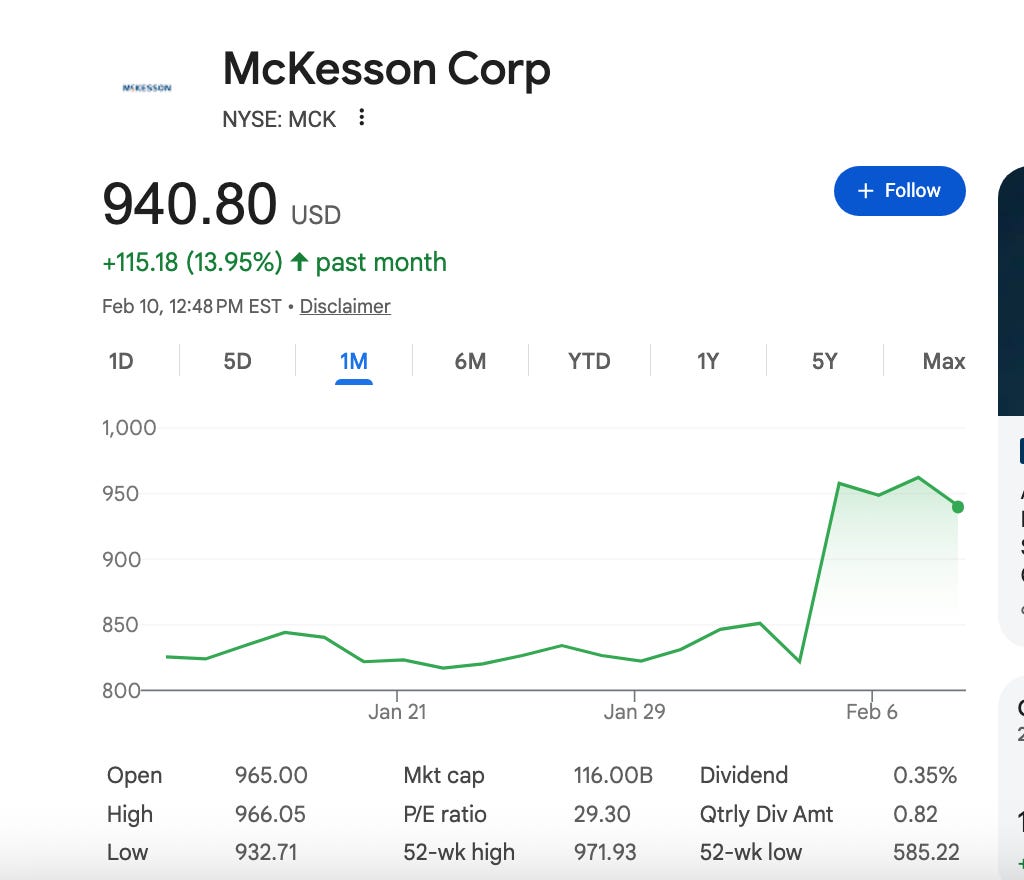
On CNBC, Jim Cramer touted this business model, discussing President Trump’s failed crackdown on healthcare costs. “The middleman McKesson today is leading the S&P,” he said. “This is a company that the president, it’s in his crosshairs. He has failed. They are more powerful than President Trump.”
In the 19th century, some doctors would make so-called patent medicine – really, unpatented cure-alls for conditions like colic or “female complaints,” often fortified with alcohol, opium, and cocaine – and then sell them to patients, including infants and children, with predictably tragic results. Starting with the 1906 Pure Food and Drug Act, Congress passed laws to bar these practices, and today it’s illegal for doctors to get paid or receive kickbacks for prescribing certain medicines.
What McKesson – and the other “Big Three” wholesalers, Cencora and Cardinal Health – have done is to restore this model, at scale, with Las Vegas – or Disney World and PGA golf courses – thrown in the mix. Only this structurally unethical practice now happens through the antiseptic term “vertical integration,” validated by Wall Street economists like Peter Orszag, who see such practices as efficient. We haven’t yet seen the scandals emerge from drug wholesalers running cancer clinics, but I imagine we will. After all, regardless of the conflicts of interest related to owning oncology practices,, McKesson, Cencora, and Cardinal Health have all been heavily implicated in the opioid crisis. So it’s hard to imagine them as paragons of medical ethics.
Conflicts of interest in medicine are not limited to wholesalers, of course. We’ve seen health insurers and drug store chains and pharmacy benefit managers (PBMs) and provider groups combine into giants, seven of which rank among the Fortune 20, with annual revenues larger than the GDP of mid-sized European countries. UnitedHealth Group, the biggest of Big Medicine, is the nation’s largest insurer, physician employer, and claims processor; third-largest PBM; and fourth-largest pharmacy operator.
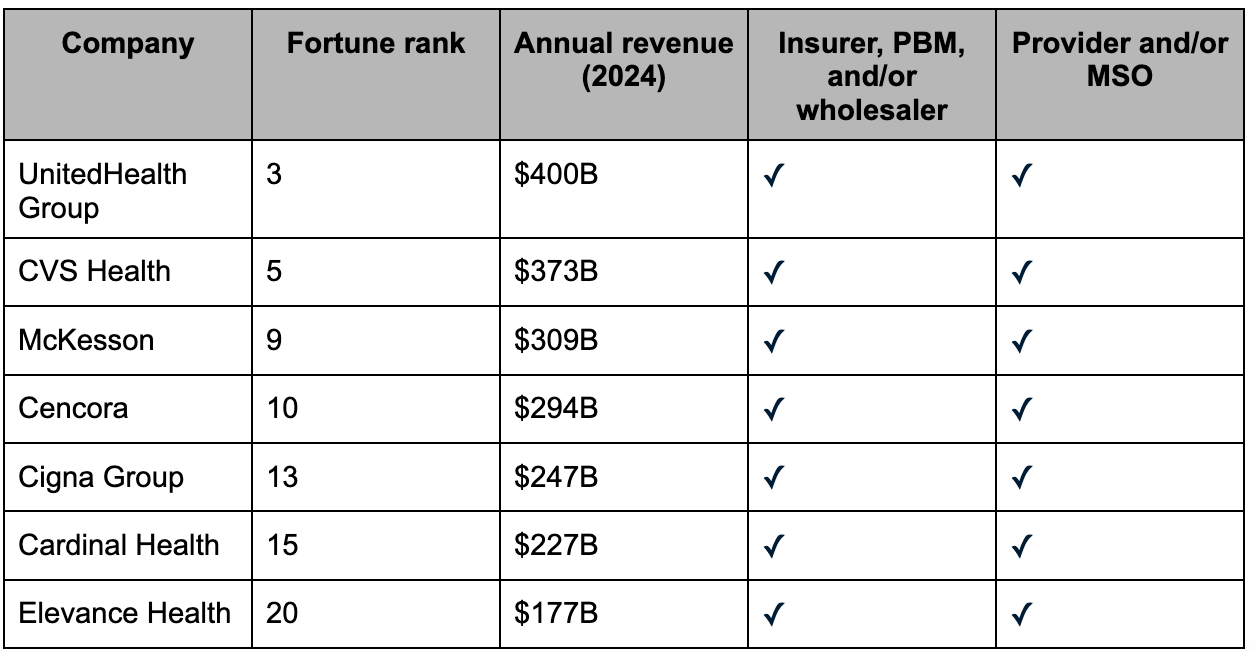
The stated rationale these firms use is that bigness is more efficient, lowering costs for consumers, patients, whomever. There are reams of evidence to the contrary. Indeed, a recent study found UnitedHealth Group pays its affiliated providers 17% more than unaffiliated competitors – and up to 61% more where it has at least 25% market share.
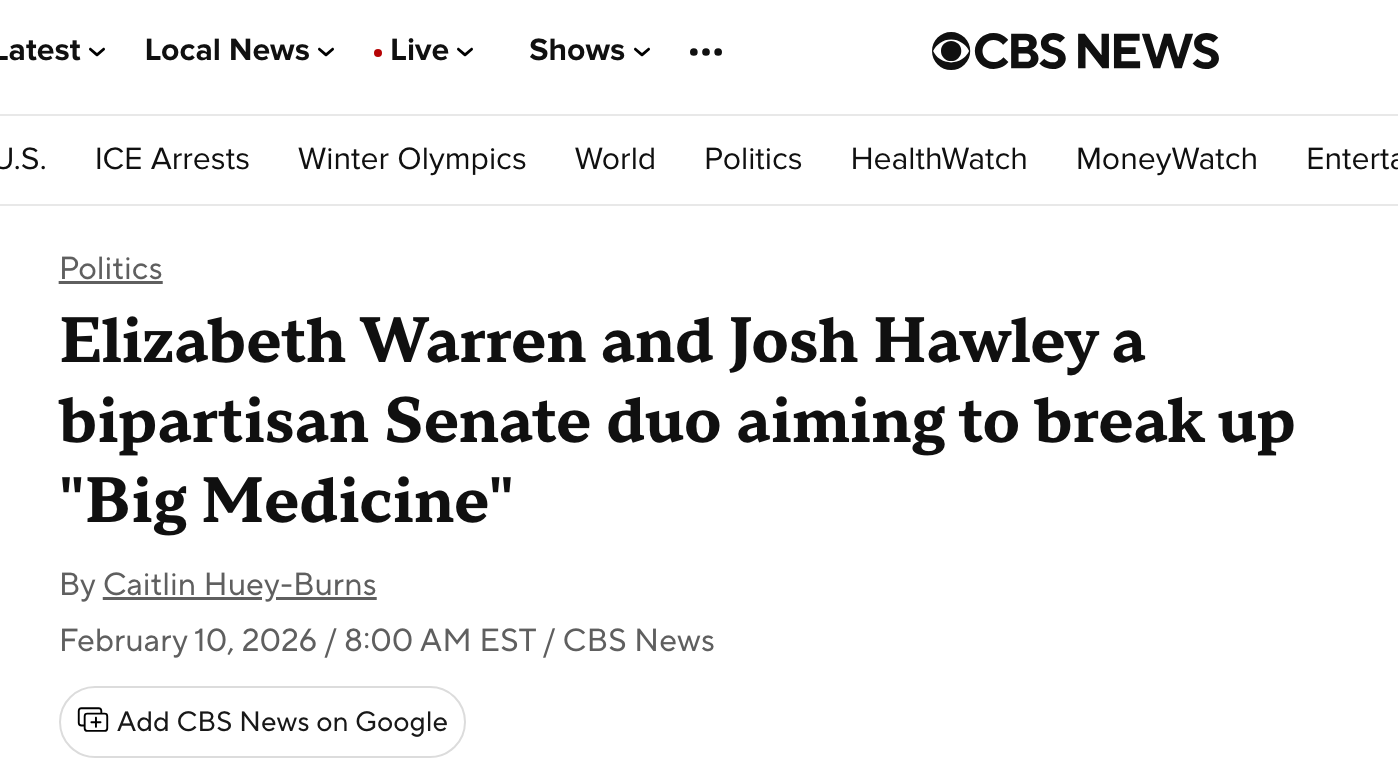
Americans and our political leaders are increasingly refusing to accept the argument that big vertically integrated health conglomerates do anything but waste time, money, and lives. State and federal policymakers have proposed a host of policies, and even passed some, that nibble at the problem. But the biggest and best one just dropped. Earlier today, Senators Elizabeth Warren (D-MA) and Josh Hawley (R-MO) introduced the bipartisan Break Up Big Medicine Act, which would splinter companies like McKesson and UnitedHealth Group.
Drawing inspiration from the 1933 Glass-Steagall Act, which structurally separated commercial and investment banks following the Great Depression, the Break Up Big Medicine Act would prohibit insurers, PBMs, and wholesalers from owning medical providers, including pharmacies, or controlling them via what’s called a management service organization (MSO). To ensure compliance, it would enable federal agencies, state attorneys general, and private citizens to bring civil enforcement actions. Lastly, it would authorize the Federal Trade Commission (FTC) and Department of Justice to block future actions – such as mergers and acquisitions – that revive this dynamic.
The idea is that we need to put power back in the hands of clinicians and patients, and move it away from the vertically integrated financiers. The American Economic Liberties Project – where I work with Matt – launched the Break Up Big Medicine initiative last February, and this legislation is a big part of it.
In practice, the Break Up Big Medicine Act would force the “Big Three” wholesalers to choose between distributing drugs to providers or owning the providers to which drugs are distributed. UnitedHealth Group, CVS Health, Cigna Group, and Elevance Health would have to choose either their insurance and PBM business, or everything else.1
In doing so, the bill would eliminate the conflicts of interest that arise when one parent company finds itself on both or multiple sides of a healthcare transaction. It would empower providers, who are increasingly employed by Big Medicine conglomerates that compromise their clinical autonomy or else compete with them on an uneven playing field. It would protect consumers, including the patients, employer health plan sponsors, and taxpayers who pay more when distributors favor higher-cost drugs, PBMs favor their affiliated pharmacies, and private Medicare Advantage insurers open geriatric clinics. Lastly, it would supplement antitrust enforcement with structural rules, stemming from the Bible. Namely, “No one can serve two masters.” If you want to be an agent for a buyer, you can’t take money from the seller, and vice versa.
The Coming End of Corporate Medicine
Does this bill have a chance? The answer is yes, because it’s part of a trend. While it is often hard to discern, there is an increasingly sharp departure from the status quo in health care policy, moving power away from financiers and towards doctors and government price setting.
In 2017, several state Medicaid programs – starting with West Virginia – reverted to a fee-for-service model for prescription drug benefits, saving tens to hundreds of millions of dollars annually by “carving out” private insurers and PBMs. Other conservative leaning states followed along, as Stoller wrote last year in his piece Ohio, Kentucky Go FULL COMMUNISM on Pharma Prices.
In 2025, Arkansas passed a first-in-the-nation law prohibiting PBMs from owning pharmacies, which one researcher estimates would reduce drug prices by 7.3%. This guess may be conservative; a January 2025 FTC report found the “Big Three” PBMs – CVS Caremark, Cigna Group’s Express Scripts, and UnitedHealth Group’s OptumRx – paid their affiliated pharmacies up to 7,736% more than unaffiliated competitors.
At the federal level, the 2022 Inflation Reduction Act authorized Medicare to negotiate lower prices with prescription drug manufacturers on behalf of older Americans and taxpayers, an admission that private Part D insurers and their affiliated PBMs had not meaningfully disciplined prices. The first batch of 10 negotiated drug prices took effect on Jan. 1 and are estimated to save Medicare $6 billion – or 22% – this year alone.
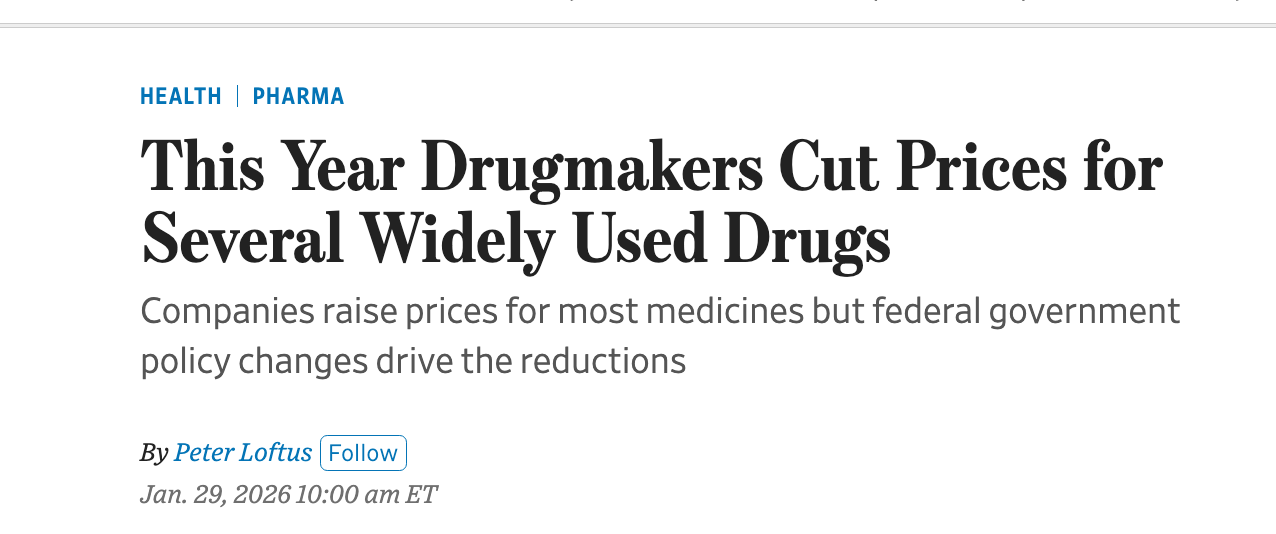
Last month, after years of struggle, Congress passed a law changing Medicare to regulate pharmacy benefit managers as public utilities. The FTC just forced the PBM Express Scripts to do something similar for commercial plans. Last week, the Trump administration proposed keeping federal payments to private Medicare Advantage insurers stagnant in 2027, a rebuke of high costs. They also included a provision to crack down on upcoding, a practice of Medicare Advantage insurers that can bilk taxpayers.
And that’s just the policies that have passed legislatures or otherwise been put into effect. There are endless hearings in Congress, and proposals to restructure these firms. For instance, during a hearing last month with five Big Medicine executives, Rep. Alexandria Ocasio-Cortez (D-NY-14) called for a Glass-Steagall for health care. Tomorrow is yet another hearing, this one on these same corporate middlemen operating in the drug supply chain.
In December 2024, Senators Warren and Hawley introduced the bipartisan Patients Before Monopolies Act, a template for Arkansas’ law. Senators Warren and Hawley are both trust-busting thought leaders within their own parties. In the House, Reps. Jake Auchincloss (D-MA-4); Diana Harshbarger (R-TN-1), a pharmacist; Greg Murphy (R-NC-3), a physician; and Val Hoyle (D-OR-4) have co-sponsored breakup legislation or at least endorsed the concept. Red states have largely led the charge on PBM reform, while blue states, like Oregon, have taken on the corporate practice of medicine. In September 2025, Democrats introduced the Patients Over Profits Act, which would prohibit insurance conglomerates from owning certain Medicare providers, with similar implications.
Something Is Brewing And About to Begin
For decades, both political parties have entrusted private financiers and large corporations with the expansion of care, imagining that hard-hearted bankers could demand savings where profligate doctors and reckless patients would not. As part of the neoliberal shift, Congress moved federal healthcare payment policy from a fee-for-service model, in which providers are paid for each service a patient receives, to a value-based care model, in which private insurers and PBMs “manage” healthcare spending. And they encouraged corporate consolidation, to promote efficiency.
But this approach has resulted in higher costs and more bureaucracy. Instead of saving taxpayer and patient money, the bankers, in a shocking surprise, just kept it for themselves. This shift has funded the rise of Big Medicine conglomerates, which wield their market power to raise and obfuscate prices, among other harms.
At this point, everyone, from patients to clinicians to employers to nurses to unions, hate the existing system. President Donald Trump has called on Congress to lower healthcare costs and “hold big insurance companies accountable.” Billionaire Mark Cuban, the co-founder of Cost Plus Drugs and a prominent surrogate for Kamala Harris, says the same thing.
As does the public. In a recent poll conducted by YouGov and commissioned by the American Economic Liberties Project, a supermajority of U.S. voters – including 72% of Democrats and 70% of Republicans – supported breakup legislation. And doctors themselves, a traditionally staunch conservative lobby, are increasingly revolted by the control these corporate goliaths exert over their practices.
Everyone understands that it’s time to break up Big Medicine. The only unanswered question is whether Congress is capable of once again acting in Americans’ best interest, as they did in 1906 and 1933. Big Medicine and its shareholders will balk, claiming that their conflicts and record profits really are good for patients. But this bill is a win for everyone else. Except health care conglomerate CEOs. And maybe the Wynn.
Thanks for reading! Your tips make this newsletter what it is, so please send me tips on weird monopolies, stories I’ve missed, or other thoughts. And if you liked this issue of BIG, you can sign up here for more issues, a newsletter on how to restore fair commerce, innovation, and democracy. Consider becoming a paying subscriber to support this work, or if you are a paying subscriber, giving a gift subscription to a friend, colleague, or family member. If you really liked it, read my book, Goliath: The 100-Year War Between Monopoly Power and Democracy.
cheers,
Matt Stoller
1
Because of the way it defines MSO, the bill would have the added benefit of forcing UnitedHealth Group to divest its claims processor, Change Healthcare, which it acquired in 2022 despite serious antitrust concerns. A 2024 cyberattack on Change paralyzed the U.S. healthcare system, resulting in cash-flow crises – and worse – for its provider customers.

Lexington, KY; Naples, FL


Dorothy Parker famously (but probably not really) said, “I hate to write, but I love having written,” which is a sentiment I don’t largely understand or agree with in the broader sense, but certainly have experienced during a kick-to-the-nuts writing day where the words arrive with the effort of trying to do proctology on a stampeding horse while both you and the horse are blindfolded. But as it turns out, there’s a sort of third level to this notion, one altogether more troubling and ultimately even less understandable: “I hate to write, I hate to have written, I mostly just want to be published.” Or, “I really just want to have money.” Or, “I actually want to just use as few keystrokes as possible to make my computer barf up stolen artistic authorial valor onto the internet in the hopes of charging absolute rubes a couple bucks for the narrative puke I hastily urged into a book-shaped pile.”
What I’m trying to say is, I read that NYT article about author — sorry, “author,” with airquotes as pissily vigorous as you can make them — Coral Hart, a self-proclaimed ugggh “AI evangelist” who over the last year has made AI churn out over 200 novels across nearly two dozen pen-names.*
Reading that makes me feel so angry and so sad at the same time — some combination of fury and weary sorrow for which the Germans must have a word. It’s hard to even articulate my objection, I’m so grossed-out by that — I wasn’t even sure I could mount a cogent response to any of this that didn’t end up as just angry mouth noises and erratic gesticulations. (Which is better, one supposes, than geriatic ejaculations.) Mostly I just want to post a series of photos depicting the faces I’m making, which likely run the gamut of “trying to hold back my rising gorge” and “watching a lion eat a human baby” and “kill me kill me now all of time and all of technology and this is where we ended up oh god just go back in time and end it all before it ever began.”
So, instead, I thought I’d tackle one particular thing Coral Hart (which is itself a pseudonym, since retired) said, and it’s this:
“If I can generate a book in a day, and you need six months to write a book, who’s going to win the race?” she said.
Ahhhhh. What the fuck. Ahhhhhh. AHHHH. That’s not — that’s not how any of this works, Coral! But this smug “winner” attitude is the absolutely natural apotheosis of the Internet’s obsession with churning out content. Generic, shapeless, formless content — a slurry machine where you turn the pipe on and lorum ipsum diarrhea comes shooting out at maximum pressure. It is the natural outcome of a race-to-the-bottom low-price churn-and-burn self-publishing environment, to boot — it’s less move fast and break things and more move fast and make broken things, because who cares, dipshits will pay for it.
This is the equivalent of, “Well, if I can blow up a cow with dynamite in ten minutes, but you need three hours to butcher it, who’s going to win the race?”
But of course, in the quote — a quote which is itself a cocky, smug assertion of superiority based purely on speed — is buried a greater, uglier truth.
If I can generate a book in a day–
and you need six months to write a book–
She’s not writing anything.
And she knows that.
She’s “generating” it.
Intrinsic to this is, “ha ha, you dumbass, over there still writing books like an asshole, whereas me, I just use a computer to do it for me.”
Except, intrinsic to that is the reality that the computer didn’t make that stuff up either. You know who did? We did. Actual authors. Real writers! We wrote the stuff, the fascist techbro fuckwads stole what we wrote, and then ticks and leeches like Coral Fucking Hart are happy to drink the blood those monsters have already stolen from us. She is churning out 200 books a year not out of the ether, but by drilling into the ground and drawing up the juice of an infinity of other books**, all stolen, all turned to narrative petroleum to fuel her fantasy of being a real writer.
And that is a fantasy.
Because Coral Hart is not a real writer.
Coral Hart is an opportunistic vampire — a thief, a grifter, a lazy pick-me.
She’s not even a master vampire. No, the master vampires are the ones who built this plagiarism machine. She’s just a ghoulish neonate, a feral bloodsucker down in the sewers happy to feed on the blood-soaked fatberg formed in the tunnels by the elder lords.
She’s a “writer” the same way I’m a “chef” when I pull a frozen dinner out of the fucking microwave. Someone else did all the work and packaged it together. I just hit the buttons and set the time.
So, to remind you:
Writers who use AI —
Are not real writers.
And this comes after years, years where Authorial Discourse has worked very hard to build all these fences in order to define who gets to be a Real Writer — and up until this point, all those fences have been false, bullshit borders. They’re illusions. I’ve long said that the test is so, so simple: real writers write. That’s it. That’s what it takes to be a writer.
Writers write.
And writers who use AI?
They’re not writing, are they?
They’re churning. They’re clicking buttons. They’re stealing. They’re plagiarizing.
But they’re not writing.
And they don’t even want to be writers. Because if they wanted to be writers, guess what? They’d fucking write! They’d want to write! Because writing, even on the worst day, the hardest day, is glorious. Even when the words suck and you break your teeth from grinding them so hard, it’s still a powerful, formative experience where you take all that you know and have been and have dreamed and are afraid of — you take all of that and you turn it into something else. You crystallize it. You coalesce it. You turn all this stuff that exists invisibly in your mind and make it visible on the page, inventing new people and new worlds and strange situations and you reach for revelations about love and hate and jealousy and all the ideas both big and small. You take nothing and you make something.
So powerful.
But AI acolytes don’t do any of that.
They wait for you to do it, sure.
Then they stick their greedy teeth in and tear off a piece.
The saying goes, why would I want to read something you didn’t even bother to write, but then we must also ask, why do THEY want to do it? Why does someone want to publish something they didn’t write, didn’t conceive of, didn’t edit, didn’t gestate, didn’t birth forth across amazing and frustrating writing sessions? Because it’s all just a get-rich-quick scheme. That’s it, revealed. Coral Hart gave up the game. She doesn’t want to write.
She just wants to generate, just wants to get paid, get that money, so fuck writers, fuck readers, fuck you.
Real writers don’t use AI.
That’s the red line.
* It’s unclear if she even makes much money at it, but she does make money teaching you how to make money at it, which is a profound irony and ultimately ends up being one of those get-rich-quick schemes where you see an ad in the paper telling you how to make all this money stuffing envelopes but what you’re stuffing the envelopes with is the exact same information you got about making money stuffing envelopes, which is to say you’re charging people money to tell them secretly that you’re scamming them and now they can scam other people too, an endless human centipede of shit being passed down the line, ass to mouth, mouth to ass.
** Note too the absolute gall she has to act cocky as fuck about this when she’s using Anthropic’s Claude, which was verifiably built on stolen books, including mine, and has been proven through a class-action suit!
Anyway!
Buy my books! A human wrote them! (Ahem: me.) Humans edited them. Humans designed them inside and out. Humans helped sell and market them, both at a publisher and at a bookstore. You could even gasp order my newest, my demonic novel, The Calamities, coming out in August. I’ll even, as a human, sign it and personalize it and tell you who your DEMONIC PROGENITOR secretly is. Do it. Preorder it. Make us humans happy, please and thank you.
Lexington, KY; Naples, FL

Sure, tech stocks might have dropped a bunch this week, but the big news is that Anthropic is running its first Super Bowl ad, lampooning OpenAI’s recent decision to sell ads in ChatGPT searches. (According to the ad, “Ads are coming to AI. But not to Claude.”)
Even Sam Altman admits that it’s funny:
From what I gather, OpenAI will run some ads, too.
In the Super Bowl spirit, I have outlined today’s match-ups below. As you can see, the two big private LLM companies, although superficially similar, are actually quite different. Or at least I think that’s what you can see? Hmm….
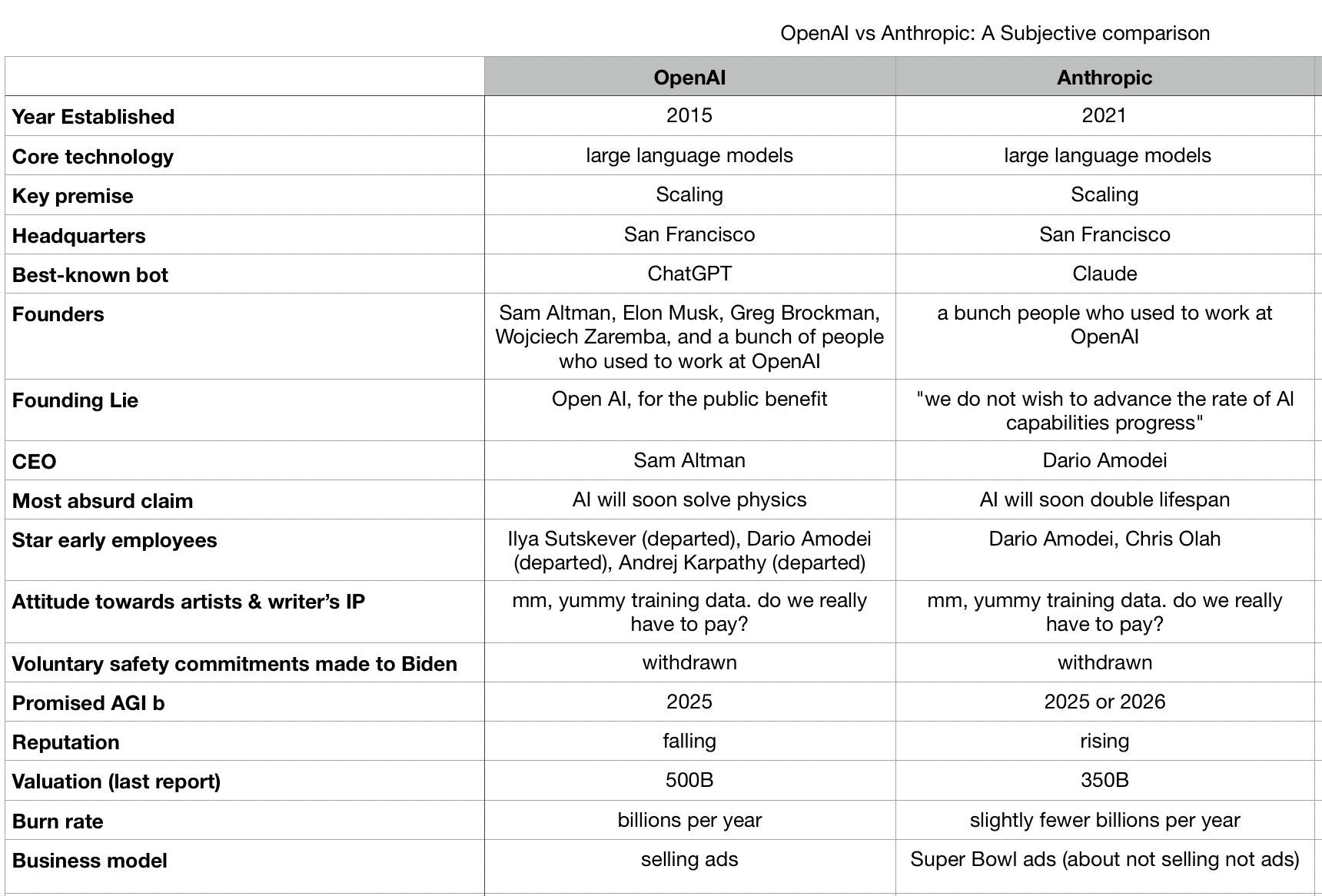
Kidding aside, I do think there are some real differences. OpenAI gave lip service to AI regulation at the US Senate; Anthropic actually supports regulation. And Anthropic is (so far as I can tell) doing a better job of supporting its business customers.
But at the end of the day, it’s a bit of Coke vs Pepsi: two slightly different products (with their own sets of loyal fans) fighting tooth and nail for more or less the same market.
Small wonder that they are now turning to ads.
Actually watched the SuperBowl with the sound off.
Claude came up more then Open AI.
Claude came up more then Open AI.
Lexington, KY; Naples, FL
Next Page of Stories