Scientists have discovered new evidence that the cosmic structures connecting the universe are much larger than previously predicted—persisting over billions of light years—a finding that challenges a core tenet of cosmology and hints at the possibility of new physics, according to a study published on Wednesday in Nature.
The standard model of cosmology, a well-corroborated framework for understanding the universe that is also known as the Lambda cold dark matter (ΛCDM) model, predicts that the large-scale structure of space looks the same in all areas (homogeneity) and in all directions (isotropy). While there is variation in the distribution of matter on small scales, such as thousands or millions of light years, these distinctions should smooth out into a uniform pattern on the scale of the cosmic web, which is a network of large-scale structures made of dark matter, gas, and galaxies that stretches across the universe.
But in recent years, new observational data has started to hint that galaxies cluster in “preferred directions,” forming distinct structures known as “anisotropies” that are not uniform, even across vast distances. Now, a pair of physicists has discovered that these distinct directions and patterns persist even to the scale of a gigaparsec, which is a unit equal to 3.26 billion light years, possibly signalling “the need for a shift in modern cosmology,” according to their new study.
“The structures observed in the real Universe are significantly larger and more persistent than those formed in state-of-the-art simulations based on the standard model of cosmology,” said authors Francesco Sylos Labini of the Enrico Fermi Research Center in Rome, Italy, and Marco Galoppo of the University of Canterbury in Christchurch, New Zealand, in an email exchange with 404 Media.
“The key advance of our analysis is that it allows this difference to be quantified,” they added. “By measuring the spatial extent and coherence of the observed structures and comparing them directly with theoretical predictions, we found that the discrepancy is statistically highly significant. In other words, the largest structures in the real Universe appear to be substantially larger than expected in standard models of galaxy formation.”
According to existing models, the cosmic web emerged from small density fluctuations in the early universe and gradually developed into large-scale filaments and nodes made of dark matter that gravitationally attract gas, galaxies, and other forms of matter.
Last year, the Dark Energy Spectroscopic Instrument (DESI), a major astronomical survey based in Arizona, released the largest high-resolution 3D map of the universe, which has revolutionized cosmology and allowed scientists to test those theories against observational data.
Labini and Galoppo analyzed the DESI release with statistical tools, including the Angular Distribution of Pairwise Distances (ADPD), which is especially effective for detecting and characterizing large-scale anisotropies in DESI’s dataset.
“The idea was to try to really test whether the idea that isotropies reached very large scales is now supported by data,” said Galoppo in a follow-up call. “Even just five or ten years ago, we didn't really have the data to test on gigaparsec scales. But now, we had a chance, so we decided to take it.”
“What we are able to do is to characterize how large are the largest structures inside this sample” of DESI observations, added Labini in the call.
The results revealed that even in DESI’s super-zoomed-out observations, large-scale structures create preferred directions of galaxy distribution, as opposed to an overall isotropic pattern. This contrasts with expectations derived from the cosmic microwave background, the oldest light in the universe, which suggests that directional correlations should fade rapidly at large scales.
“In the standard model, it's not that there aren’t structures,” said Galoppo in the call. “It is just that they are supposed to be smaller and less persistent than what we found. That's the crux of the matter.”
To that end, DESI is expected to release a new batch of observations within a year, and similar datasets will also be forthcoming from Europe’s Euclid space telescope and the Vera C. Rubin Observatory in Chile in the near term. These new and improved views of the universe will help scientists grapple with just how vast these large-scale structures are, and what that means for our understanding of our cosmic surroundings.
“At present, there is no simple or widely accepted modification of the ΛCDM framework that naturally explains structures of this size while remaining consistent with the observed uniformity of the cosmic microwave background,” Labini and Galoppo wrote over email. “That is precisely why these observations are so interesting: they point to a potentially important gap between theory and observation that deserves further investigation.”
“If future surveys continue to find coherent directional structures on even larger scales, the implications for cosmology would be profound,” they concluded.
One aspect of strategy that’s been largely lost in the tech industry in recent years is how to compete against platforms, since the major tech companies have gotten so big that markets are no longer competitive. However, the AI market is still early enough, and users and society are still angry enough, that the Big AI companies can lose.
But for them to lose, everybody else in the ecosystem has to carry out the nearly-lost art of platform strategy. Tech companies (and even open source communities!) used to carry out these tactics in emerging product categories ranging from desktop office suites to operating systems to web browsers, though over the decades, the lesson that big tech learned was, basically, that they should play dirty.
You win platform strategy battles through power and persuasion. We're going to get both.
Historically, we would have relied on regulators or media to help hold bad actors in the tech space accountable, but in the United States, these entities are largely not going to help very much. Some state and local governments may assist, and some independent journalists or smaller media outlets are pushing for accountability, but the most powerful entities are either captured or complicit in many cases, so we don’t have the institutional pushback that had sometimes been present in earlier points of technological change.
The thing that matters right now is that we understand that all of the Big AI companies are extremely vulnerable. The reason they’re making so much noise, and spending so much money, is because they know that they’re vulnerable. Users, and especially users who are developers have an enormous amount of leverage to control where AI goes. And if those communities of users can coordinate, they can put power back into the hands of the people. Today, that means focusing on some technical interventions, along with the cultural and political pushback that’s happening. That’s how we begin to reduce, or even prevent, some of the worst AI harms in the future.
Here are some of the proven tactics that have helped shift the balance of power in prior tech reckonings:
1. Get in front of it
The first and most important technical goal is for everyone to push for all AI usage to be disintermediated — where users access their AI apps or services through open tools or interfaces that aren’t controlled by the Big AI companies. These tools, in the form of “harnesses”, or through text editors or command lines, or just through the familiar chat interfaces that lots of people use, need to move as quickly as possible to being controlled by community-built, open options. The sooner this step happens, the sooner we unlock the ability to shift decision-making power out of the hands of the corporate platforms, and begin to undermine their ability to cement lock-in of users.
Status: Good. There are a number of popular, mature tools in almost every category for users who want to access today’s AI tools through a free, open interface. Most of the work now is to get the word out about these tools, and to continue to polish and improve the user experience so that they offer features and design touches that the commercial tools can’t or won’t.
2. Spread the love around
Another key capability that the open ecosystem must provide is the ability to seamlessly switch between different AI providers on the fly, to reduce costs, to provide better performance, or to get both benefits. In many cases, this will be seamless and automatic, just making the right choice for users so that they get the best option all of the time, but advanced users will want to tweak their settings, like when businesses may want to be very aggressive in minimizing the amount of money that their employees are allowed to spend on AI services.
The important part here is that this forces AI platforms that want to compete to remain compatible with all of their competitors, keeping the market dynamic, and ensuring that all of the big providers are easily replaced with another vendor at any time. Basically, we always have to be able to keep them in their place, and they should know that they could go away at any time. Most companies are aware of these needs, but the more regular consumers are familiar with these kinds of requirements, the more pressure there will be on companies to conform with standards. (This is also what will enable the disintermediation mentioned in point 1.)
Status: Good. This is happening already in business environments, where companies demand this kind of flexibility. Developers have been creating very dynamic systems for switching between AI providers, and the ecosystem encourages this kind of switching by extensively comparing different AI platforms against each other whenever new models are released. The important thing to maintain here is the narrative that none of the individual models matter more than the overall ecosystem — and that even the biggest companies have to conform to the same strict formats and standards as the independent AI systems created by communities around the world.
3. Free the tools
Another vital concern for shifting power away from the Big AI companies is undermining them economically. Instead of simply following the classic “commoditize the complement” strategy that commercial companies often execute, open source projects created by a community can more straightforwardly pursue a path of enlightened value destruction. Non-commercial LLMs have been roughly keeping pace with the Big AI platforms, following the pattern I described as “frontier minus six”, where free and open models lag about 6 months behind the most cutting-edge AI labs — which means they’re still pretty freaking great for most uses.
In a scenario where there are extremely capable models that cost nothing except for the price of keeping a few servers running, as well as very robust tools that make it effortless to seamlessly switch between models (see point #2!), more and more organizations will shift more and more work away from the Big AI companies, especially as those companies keep raising their prices.
But there’s no reason that these same principles can’t be followed by ordinary consumers as well. Many developers are already using these techniques to switch to free models to save money, and the only barrier to this practice becoming more widespread is that the user experience is still too clunky and technical for most regular people.
Status: Okay. Lots of people are working on this, and in some scenarios, the free AI tools are even pretty great. But for the most part, there are still too many compromises in either the end results or the user experience for this to be a mainstream alternative today. This can change, with the right investments and focus on improving things — and focusing on differentiation in areas where the open community can distinguish itself from all of the Big AI companies.
4. Get angry too
Pretty much everybody who’s from the 21st century, or anybody who’s a creative person, is pretty furious about AI. Anyone who’s not oblivious to culture is aware of that. Yet all of the Big AI companies keep treating it like some fad that’s going to blow over, or a trend that they can just steamroll with their dollars. This isn’t going to go the way they want.
However, the people who will build the alternatives can actually listen to the values and criticisms of the people who are angry, and make tools that respect and respond to what they’re saying. An Internet of consent is not only possible, it’s all around us, if we choose to respect it. If people hear that they can get some of the conveniences or features that they were previously told were only possible with extractive, exploitative, evil AI tools, but without any of those negatives, they’ll actually be pretty happy to hear it.
Today, usage of AI is high enough that even some of the people who hate AI are using it. Some of this is due to the coercive way that AI is being shoved into everybody’s faces, some of it is due to there being some places that people feel it has utility that they wish they could access without its moral compromises. When people are compelled to use platforms that they object to (as a lot of people feel about using things like social media), the feelings of guilt and resentment that come along with it are deeply toxic.
What we're talking about across these first three points, if taken together, is an entirely new experience for millions of users. And that new set of platforms could respect the consumer backlash against AI and channel it into presenting tools that acknowledge their anger and treat it as legitimate. They might even be tools for fighting back.
Status: This one’s going to be tough. This is the one idea where most people think I’m crazy. People who have a righteous anger about the harms of current Big AI companies say that there couldn’t be any such thing as “good AI”, and I understand their skepticism. People who think AI is an interesting technology but hate the hype (the majority AI view) are usually skeptical that the open community could make offerings that are good enough to compete against the big commercial offerings. And AI enthusiasts are pretty skeptical that AI critics would ever come around to seeing any technology in this category as being acceptable, no matter how thoughtfully it was created or presented.
I think there’s enough anger at the trillionaire predators to go around, though.
Let’s get to work
It’s been a long time since we succeeded in wresting control of a nascent space away from the tycoons trying to take it over. But it’s pretty clear what the stakes are this time, and it’s also clear that the window for changing the path of the AI world is closing pretty rapidly.
Obviously, this kind of shift won’t be easy, but I think people would be pretty surprised how possible it is. There’s a snowball effect that happens once folks start to understand that there are appealing alternatives to the things that are making them miserable. An entire generation needs to discover that enshittification is not only not inevitable, it is downright preventable, and the power to do so rests in our hands.
If you’re a developer, you have an extra responsibility: are you vetting your work against this list? If nothing else, you need to be doing so just to ensure that you have a chance of having a career over time. But it’s also the right thing to do.
And if you’re not technical in that way, you don’t have to become a developer, but you can familiarize yourself with these concerns broadly — even if you hate AI and never want to touch the stuff! — so that you know what argument to make about how to shift the balance of power.
The most important thing to know is that, as so many people have said, none of this is inevitable. But the way we fight that inevitability is with a more exciting, human, powerful alternative, not merely by repeating what we’re saying no to. We are not simply angrily running away from something, we can all be joyfully running toward something together.
Bonus Footnotes
In the early days of tech blogging, one of the biggest reasons that so many people got used to reading Joel Spolsky’s blog was that he’d often write amusing little fables that shared key lessons about product strategy. Strategy Letter V (on commoditizing your complements), or How Microsoft Lost the API War, or Fire and Motion, or… Platforms. If you can squint past the turn-of-the-century mentions of Microsoft Excel, there are lots of interesting lessons there.
Listen to what George says, if you haven’t already. You can stop about two and a half minutes in, after he talks about how all your shit is stuff and everyone else’s stuff is shit. Because that’s the reason Big AI will never be personal AI. Big AI is not a place for your stuff. It’s a place that’s full of everyone’ else’s stuff. And yours too, probably.
Worse, Big AI is a giant digestive tract, extracting value from all the stuff in the world, hoovered up so its giant brain can make faked-up answers to anyone’s questions, make faked-up writing, faked-up code, faked-up music, faked-up art. It can fake all kinds of human output that does not require a human body. Lots of that shit is useful, helful, and hell, amazing. (I use it every day.) But it’s not our shit, even though it can serve a zillion prosthetic purposes.
We need a personal place for our personal stuff. We also need AI. How can we have the latter help us with the former?
Look at this graphic here, generated by ChatGPT for me a couple years ago, when it could draw but not spell. I put the words there using Photoshop:
What would this woman’s Personal AI be?
Start with a physical place. Even if some of her digital stuff is off-site (like in a garage or a storage unit in the physical world), she has to know that place is hers.
Apple gave us the first model for this, back in the late ’80s. It was called the Knowledge Navigator:
Hats off to Tor Hagemann for pointing us to it. Really, check it out. It’s less than six minutes long, and describes the kind of thing we need. A device, not a service alone.
The place in that video is a professor’s study. For you and me, it might be a workshop or a cabin. Whatever the metaphor, we need a home on the Internet range: one as comfortable, safe, secure, familiar, and as much ours as our home in the natural world.
Our digital stuff (such as in the graphic above) is what techies call “unstructured.” It’s many different kinds of data, organized in many different ways. AI is good at dealing with unstructured digital stuff. We just don’t have AIs of our own yet, or a place for our digital stuff. But work is going on. Let’s review some.
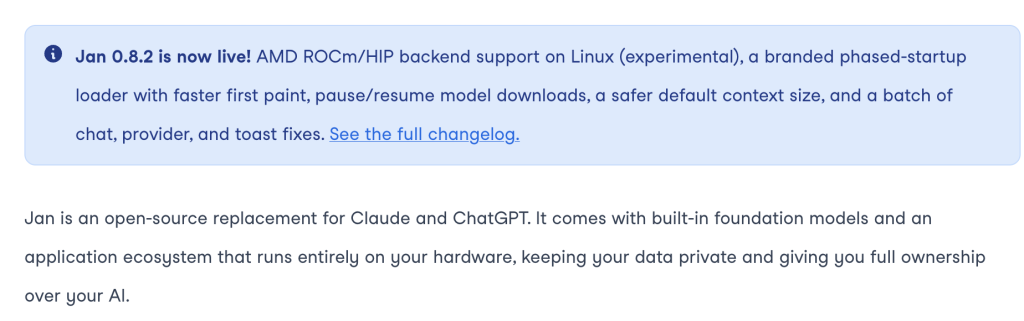
“Personal Intelligence that answers only to you.” It runs on one’s own machine, with local models of your own choice, privacy by default, and a cloud option. Here’s a grab from the website today:
OpenClaw is a personal AI assistant you run on your own devices. It answers you on the channels you already use. It can speak and listen on macOS/iOS/Android, and can render a live Canvas you control. The Gateway is just the control plane — the product is the assistant.
If you want a personal, single-user assistant that feels local, fast, and always-on, this is it.
Kwaai is an nonprofit open source personal AI R&D shop with a large and active community. I volunteer there as Chief Intention Officer—a title that plays off The Intention Economy, which at least partly inspired the company. Kwaai’s main work these days is KwaaiNet, which its Github page describes this way:
KwaaiNet is a decentralized AI node architecture for Layer 8 — the trust and intelligence layer above the traditional network stack — built by the Kwaai Foundation, a 501(c)(3) nonprofit AI lab focused on democratizing AI.
Each KwaaiNet node combines:
A decentralized trust graph (cryptographic identity, verifiable credentials, local trust scores).
Shared, sharded LLM compute over heterogeneous CPUs/GPUs using Petals-style distributed inference. Apple Silicon Macs use llama.cpp with Metal for 30+ tok/s local inference; Linux nodes use CUDA-accelerated block sharding.
Secure multi-tenant knowledge storage via Virtual Private Knowledge (VPK) with encrypted vector search.
Intent-based, peer-to-peer networking that routes based on “what I need” (model, trust tier, latency), not just IP addresses.
From an app’s point of view, KwaaiNet looks like a familiar chat-completion style HTTP API. Under the hood, it is a person-anchored Layer 8 fabric where every node is tied to an accountable human or organization.
It’s just spread across documents, notes, meetings, messages, and old decisions. Companion Intelligence brings that context together, so your agent can find what matters and help, more effectively, from where you left off.
Most AI tools are temporary, and interchangeable. They answer a question, finish a task, and forget the larger story. Companion Intelligence gives AI a private home base: a place to understand your files, projects, routines, decisions, and history without making someone else’s cloud the center of your life.
Agents for Companion Intelligence can come from elsewhere. They note two so far: Hermes and OpenClaw. They also promise “universal MCP Support for OpenCode, NanoClaw, Claude, Codex, VSCode & more.”
By offering you a server (actually a repurposed Mac Mini), Lovarys is similar to Companion Intelligence, but aiming for the professional market. Its tagline is “Professional Accounting and Legal Intelligence.” It’s a project of Tor Hagemann. Here’s his Github page.
Around all of those efforts is an emerging ecosystem that (to me) seems to be trying to turn AI into an operating-system layer. Examples include:
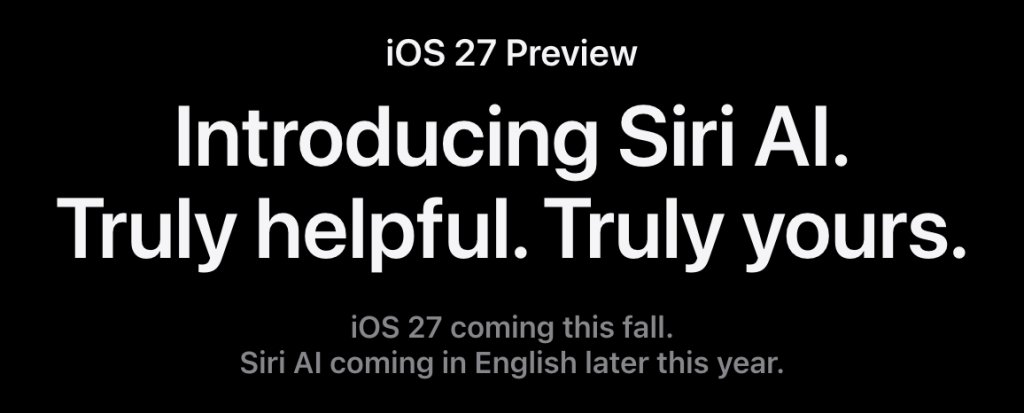
This is the big one, and it just dropped a shoe the size of a continent:
No, this isn’t it true personal AI yet. But it is beyond significant.
Siri is Apple’s Clippy. Maybe worse, because it’s still alive and unloved after fifteen years of relentless promotion and disappointment. (Start reading down from the Reception subhead on Siri’s Wikipedia page for a partial account of Siri’s failings. A lot there.) But never mind that. Instead, mind these two words:
Meaning private.
Apple is huge on personal privacy. In case you’ you’ve missed Apple’s many ads and videos, you can get the gist of the company’s privacy case here, here, here, here, and here. A couple of years back, in response to the first of those, I wrote here and here about how Apple comes up short on the privacy front, despite its many promises.But points for trying, and staying on the case, which will get a lot bigger with this next operating system.
Will what Apple brings us in version 27 of iOS and MacOS at least start to give us a place for our stuff? A truly private place? Let’s look—
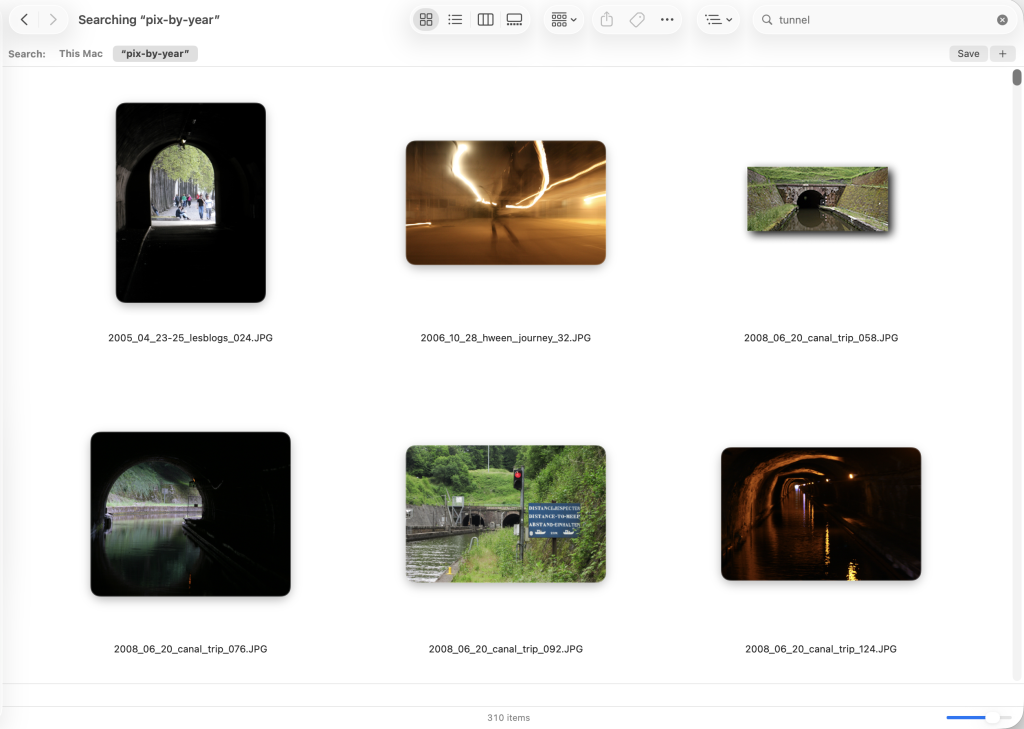
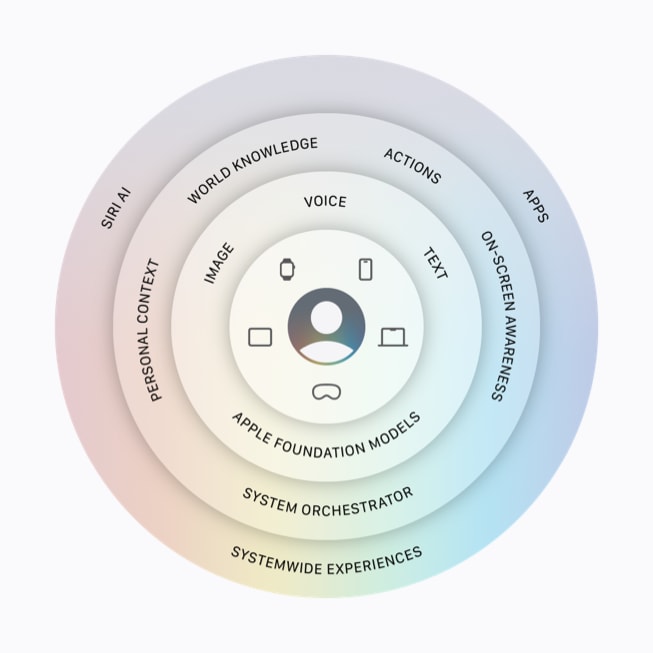
1. On-Device “Personal Context”: A new architecture (not the old Siri) maps your device locally, using Apple Silicon’s Neural Engine to index information across your Apple applications: contacts, calendar, reminders, messages, emails, documents, photos. As for your non-Apple stuff, such as my million-plus photos that are not in Apple’s Photos app, it looks like it’s already on the case. When I search for “tunnel” across my photo directories with my laptop (2023 MacBook Pro running Tahoe 26.5.1), I get every shot where that word appears, plus lots of stuff that is either a tunnel or looks kinds like one. Example:
Clearly an AI does some pattern recognition there, but is that “personal context”? I dunno,
It has “Semantic Indexing,” which makes informed presumptions about the meaning of your data, and not just your keywords. Big AI does this now, but Siri will do it just for you, on your stuff, inside your place for it. Note what it says under the “Apple Intelligence in Apps” subhead here:
Express yourself through photos and images, save time with Safari, and get more done with Apple Intelligence seamlessly integrated into your everyday apps and experiences.
But do we want “seamless” everything? We need edges, boundaries, to make sense of the world. Right now I just want the option to turn that off, or not turn it on. Unless it’s the thing that sees tunnels. I don’t know, and that’s a problem.
2. Private Cloud Compute (PCC) is how Apple describes another place for your stuff: kind of a private office in Apple’s hi-rise downtown. Specifics:
For advanced features that need to reason over complex data with larger foundation models, we created Private Cloud Compute (PCC), a groundbreaking cloud intelligence system designed specifically for private AI processing. For the first time ever, Private Cloud Compute extends the industry-leading security and privacy of Apple devices into the cloud, making sure that personal user data sent to PCC isn’t accessible to anyone other than the user — not even to Apple. Built with custom Apple silicon and a hardened operating system designed for privacy, we believe PCC is the most advanced security architecture ever deployed for cloud AI compute at scale.
The authors of that text are Apple Security Engineering and Architecture (SEAR), User Privacy, Core Operating Systems (Core OS), Services Engineering (ASE), and Machine Learning and AI (AIML)—all inside the company. They say lots more at that last link, all helpful to know. So is Expanding Private Cloud Compute, by the same teams.
3. Systemwide app actions: This new assistant can, for example, cross-reference a tracking number from your email and a message thread to find who asked for it, pull out other relevant information, then automatically drop it into a reply for you to review or edit before you send it, all in your virtual cabin (device) or office (private cloud).
4. Controlled federation, anonymized gateways, a privacy shrowd, and other jive required to make this work:
I gather, from Apple’s literature, that Siri strips out your IP address and personal identifiers before making a query to an external AI. The external AI agent sees only the isolated query. This prevents the external AI from examining the personal stuff in your online home.
5. The Mac Mini, or some new dedicated place for your stuff.
Tom’s Hardware: Apple warns Mac mini and Mac Studio shortages could last for months — local AI boom and memory crunch drive demand beyond Apple’s manufacturing capacity. (May 2, 2026)
Given all this news, I will be amazed (but not surprised) if Apple doesn’t push the next Mac Mini as the personal AI machine, meaning the place for your stuff.
Okay, so here is a table of what we’ve reviewed so far:
System
Owner
Memory
Outside AIs
Sovereign?
Character
Apple Intelligence
Apple/person
Deep
Yes
Partial
Private cabin inside Apple’s estate
Personal AI
Company/person
Deep
Limited
Partial
Digital twin in the cloud
OpenClaw
Person
Deep
Yes
Mostly
Self-hosted AI stack
Jan.ai
Person
Moderate
Yes
Mostly
Personal AI workshop
Companion Intelligence
Person
Deep
Yes
Mostly
Personal homestead
Lovarys
Professional/person
Deep
Selective
Mostly
Private study or office
Kwaai
Person/community
Intended deep
Yes
Aspirational
Cooperative village
Friend
Company
Moderate
Yes
No
Companion in somebody else’s house
Here is a tough question: What if only a giant can put together most or all of what we need? Three giants currently furnish most of our personal spaces in the digital world:
Apple (iOS and MacOS devices, Safari browser, etc.)
Google (Android devices, Gemini, Chrome browser, etc.)
Microsoft (Windows OS and devices, apps, etc.)
With iOS and MacOS 27, Apple moves to the front of that pack in the personal AI space, and will likely be the only giant to offer something that looks like a place for your stuff. Given its role in the surveillance fecosystem, Google can’t be trusted. Microsoft still has Micro in its name, but it has become much more of an enterprise company in recent years. So, among giants, Apple is it.
Now let’s talk about agents.
Apple sees you with just one: Siri, or whatever Apple lets you call it. But you will probably need many agents: one or more for health (in various specialties), financial (banking, investment, credit), travel (airlines, car rental, hotels), home economics (property, stuff in storage, scheduling the kids, keeping the car working), legal (all your contractual commitments, plus much better customer-company interactions than are possible today).
Here’s the thing: if a single chatbot request is too risky to run unverified, what does that say about agents?
A chatbot is one request in, one answer out. An agent runs that risk in a loop: reading email, opening files, calling tools, handing work to other systems, unattended and at machine speed.
No breach required. An agent doing exactly the job you gave it moves your data constantly into places you don’t control and mostly can’t see.
Now wire thousands of agents together, the way every enterprise is planning to this year. Whatever the per-step risk is, compounding turns it into a certainty.
Apple just deployed Confidential AI to protect the smallest risk surface in AI. Enterprises are wiring up the largest with nothing underneath it.
Opaque doesn’t care about you or your “smallest risk surface in AI.” It sells arms to enterprises. But it does make a good point in its opening sentence:
“Apple looked at a simple chatbot, the single most contained form of GenAI there is, and decided the data it leaks is too dangerous to ship to their customers without Confidential AI underneath it.”
To Apple, the more personal the context, the higher the privacy stakes. That’s why it believes personal AI has to run—
on-device (the place for your stuff) and
in a privacy-walled cloud infrastructure (your private office in Apple’s high-rise cloud)
The former can actually cover a lot of ground in your life, just by helping you get on top of all the stuff in your digital home. It can also handle some simple interactions with outside entities, such as MyTerms ceremonies and record-keeping.
But you’ll need much more from your personal AI if you’re going to scale your life out into the larger world, where nearly every company, every government agency, everything you might subscribe to, and even every church and nonprofit, wants to have AI agents for interacting with the you and your digital agents.
Apple Intelligence is a generative AI (GenAI) service provided by Apple on its devices. While offering a similar set of features as other similar GenAI services, Apple Intelligence is claimed to be designed with an extra focus on user security and privacy through a two-stage authentication and authorization design using anonymous access tokens. In this paper, we present our investigation into this token issuance mechanism with a goal to reveal possible vulnerabilities using traffic analysis, reverse engineering, and cross comparison with Apple’s public documentation. Specifically, we present the Serpent attack, the first practical cross-device token replay attack against Apple Intelligence that allows the attacker to steal the access tokens from the victim’s device and utilise them on a different device, with all usage rate-limited against the victim. We have achieved successful attacks on the latest macOS 26 Tahoe and demonstrated that an attacker, who even has used up its own allowance, can immediately regain access to Apple Intelligence service. We have responsibly disclosed the vulnerabilities to the vendors and received confirmation from Apple with CVE assigned and bounty given. Our results highlight a general lesson for built-in AI services: Anonymising identity does not by itself make the AI service secure; Enforcing non-transferability requires cryptographic binding to the rightful user.
We assume that Apple is addressing those concerns, plus a near-countless number of others, with MacOS 27 and iOS 27. We’ll see later this year, presumably. (Apple is better with promises and forecasts than most others, but not perfect.)
Humans invented privacy with the technologies we call clothing and shelter. We don’t have clothing yet in the digital world, or we wouldn’t be walking worse-than-naked across the Net, covered with thousands of invisible data-sucking ticks called cookies and tracking beacons: parasites that report who-knows-what to god-knows-who, across thousands of unseen and unknown paths.
But we might get shelter, or the beginning of a working model for it—a place for our stuff—from Apple and these other companies and projects.
Apple seems to understand some of this, at least architecturally, to some degree. I think others (including those listed above) understand it more deeply. But none of them have Apple’s heft.
As for the enterprise side of this, there are growing bodies of work coming from Nitin Badjatia, Iain Henderson, and Jamie Smith. All three see empowered customers coming to the marketplace with agentic AI capabilities that will strip the gears of existing enterprise systems, including those with AI agents.
Apple just set the bar every enterprise will be measured against
Escape velocity is the moment a category stops needing evangelism, when the question flips from “do I really need this?” to “why don’t you have it?” Three things flipped it this month.
First, the existence proof landed at the hardest difficulty setting. Apple just rolled out the largest Confidential AI deployment in history: every iPhone, at consumer latency, consumer cost, consumer scale. Every objection enterprises have leaned on, too slow, too expensive, more than we need, just got falsified a billion times over by a phone.
Second, this is already how the giants operate. Meta runs WhatsApp message AI through private processing. Google built Private AI Compute so Gemini can process your personal data in a sealed environment that, in Google’s own words, not even Google can access. Anthropic and TikTok run their own implementations. And Microsoft, Google, and NVIDIA ship the underlying confidential infrastructure across their clouds and silicon. The pattern is consistent: every company with world-class security talent, when forced to put AI against sensitive data at scale, lands on the same architecture. When that many teams solve the same problem independently and arrive at one answer, you’re looking at convergence.
On our side—the customer’s side—we need confidential personhood, based on personal sovereignty: root for the person. In other words, personal AI needs to be operated by the person, not just for the person.
So let’s suppose Opaque succeeds perfectly. Enterprises will have attestable hardware, secure enclaves, confidential containers, encrypted memory, verifiable runtimes, machine-speed agents, and other whatevers we’ve been reading about.
We will need the same. The flow should go like this:
Natural person
    ↓
Personal AI
    ↓
Personal terms (MyTerms)
    ↓
Confidential runtime
    ↓
Outside agents and services
    ↓
Network
Note also that the flow here is top-down from the person, the individual—rather than bottom-up from “the consumer” or “the user.”
Almost everybody talking about agentic AI today is looking only at the lower half. But that half won’t run without our permissions from the upper half. That’s why we (the working group I chaired) worked for nine years on IEEE 7012-2025—Standard for Machine-Readable Personal Privacy Terms. Its nickname is MyTerms. As I say there, MyTerms is the only way we’ll get personal privacy in the digital world. Apple, please adopt it. Everyone else, jump on board too. It’s a radically simple to implement. From that last link:
MyTerms are contractual agreements about personal privacy that you proffer as the first party, and the company agrees to as the second party. With MyTerms, you don’t “consent” to the company’s privacy policies or whatever they say about their use of cookies. They agree to your privacy requirements, which will limit the use of cookies and tracking tech to only what you allow. You are not a mere “user” or “client.” You are an independent human being operating with full agency.
In a way, Aaron Fulkerson’s post argues a need for work on the upper half. Because, while he says, “the request never travels on trust,” our social and economic lives are based entirely on trust: contracts, promises, agreements, agency, representation, delegation.
If my personal agent books a hotel, negotiates a subscription, grants limited use of my health data, tells my bank to move money, buys something, or participates in market intelligence that flows both ways, those acts and processes aren’t just computations and transactions. They are relationships. And those require identity, delegated authority, obligations, records, audit trails, and remedies. Those all need to start with My Terms.
I suspect Apple, Opaque, and MyTerms are each solving a different problem posed by a place for my stu ff:
Layer
Question
Example
Confidential computing
Can I trust the machine?
Opaque, et. al.
Personal context
Does the machine know me?
Apple, et. al.
Personal sovereignty (confidential personhood)
Does the machine represent me?
MyTerms
Dispute & accountability
What happens when things go wrong?
ODR
In each case the place for my stuff is a machine. My (or your) machine, and possibly your private cloud. Nobody today is building that whole stack. Nor should anybody. Not if we want each layer to scale.
So here is a question. What if:
Apple provides the shelter (then competitors follow),
Opaque (and its competitors) provides the locks,
Linux and open source hacks provide the plumbing, and
MyTerms provides the constitution—or at least a solid ground under a new constitution for personal agenc, independence, and privacy online?
If personal AI becomes ubiquitous, agents will do things that matter legally and socially. The questions that matter then become, “Under whose authority?” and “How is that authority secured?”
The answer to both require contracts in which the person is the first party. Fortunately, contract law is well established everywhere, and contract itself is specified by Article 6 of the GDPR as one the the lawful bases for others to process one’s personal data. (Dive deeper here if you like.)
So, while we wait for Apple to drop the other giant shoe, let’s get its alternatives farther downstream, and start putting MyTerms to use. Our home—places for our stuff—on the Net won’t be secure without them.
Why do I want to fool with this? I would have little enough work for a personal AI agent that I am sure it would take me more time to set it up & train it that is would for me to just do the miniscule amounts of work myself.
In This is a Message to Persons Unknown: The Story of Poison Girls, Rich Cross highlights a 1982 debate organized by Johnny Waller and Winston Smith, journalists from the 1970–91 weekly music magazine Sounds. Centred around the question of ‘Is Punk Dead?’, the panel brought together Poison Girls’ guiding force, guitarist and vocalist Vi Subversa, alongside Beki Bondage (Vice Squad), Colin Jerwood (Conflict) and others.
In many ways, Subversa’s response to this question captures the spirit of Rich Cross’s Poison Girls history by illuminating the complexities, integrity and legacy of a band foundational to anarcho-punk as a genre and ethic. Vi Subversa, born Frances Sokolov, responded to the Sounds journalists’ antagonistic question with the assured clarity and grounded wisdom of a woman refusing to entertain bullshit: ‘punk is about life; punk was about taking my life for myself. There’s no way I can say punk is dead, because while I’m still alive and kicking I need a word for it and “punk” will do’ (177). Poison Girls were not interested in getting caught up with petty genre debates, competitions for subcultural capital or the simplistic allure of nihilism. Poison Girls reminded us that punk is about life and all of the ugliness and beauty that comes with living. They showed us how we subvert power by asserting our own power and creating more possibilities for others to do the same.
Cross traces Poison Girls’ origins back to how Subversa established her creative life as a single mother in the days prior to punk’s emergence, discussing her role in radical cabaret The Body Show as well as anarchist and feminist political organizing. Poison Girls challenged the ‘year zero’ mentality of punk and drew vital connections to pre-existing countercultures that informed the punk ethos. Historicizing the band’s involvement in leftist movements showcases how Poison Girls were a rare entity within punk itself. The band’s Essex communal home, Burleigh House – located just a few blocks from Crass’s Dial House – became a hub for nurturing the parallel and ultimately convergent forces of Poison Girls and Crass through creative collaboration and radical dialogue. Vi Subversa and original drummer Lance d’Boyle – both of whom were years ahead of their Crass contemporaries – emerged as vital mentors to younger punks like Crass and Honey Bane (who was released to Subversa’s care from a group home). Poison Girls raised the consciousness of younger punks about motherhood, gendered divisions of labour and other pressing topics flying under the radar of boys singing familiar refrains about war.
Rich Cross’s book moves from meticulously charting the band’s early days into chapters organized around each of the band’s albums, considering Subversa’s lyricism, guitarist Richard Famous’s archival contextualization and formative creative partnerships that shaped Poison Girls’ evolving sound and aesthetics. He starts with the band’s 1979 debut album Hex, which asserted Poison Girls’ political perspective, conveying to audiences that the group had nuanced takes on topics such as non-violent resistance and the isolation of domesticity. Songs like ‘Crisis’ share how experiencing unfolding crises like economic downturn and geopolitical strife from the confines of the home is lonely and demoralizing in a way that only those responsible for feminized social reproduction can speak to. Subversa’s embodied resistance to social expectations within and outside punk as a 40-something-year-old woman steering a band made waves amongst journalists and punks alike. Male journalists like Phil Sutcliffe and Paul Morley of Sounds were intimidated by Poison Girls taking aim at topics like misogyny, as Richard Famous recounted Sutcliffe saying, ‘the men in the band must be masochists’ (74).
Funnily enough, while Paul Morley ultimately offered a positive review of Hex, that only happened after Subversa swung at him for taking cheap shots at her appearance in an earlier review of a gig, calling her ‘a middle aged woman stuffed in a red dress’ (46). Not only was Subversa unafraid of standing up to the ageism and sexism of male reporters, she was also insistent on not kicking young people out of shows who acted up and threw things at them. She recognized the band needed to earn respect as kids in the audience were rightly distrustful of authorities – of anyone over 30. From Burleigh House to the establishment of DIY space the Vault, to using each show to welcome rabble-rousers and supporters alike, Cross highlights a key thread of the Poison Girls ethos: cultivating space for anyone who might benefit from their message, rather than creating echo chambers of like-minded punks.
Cross shifts into discussing the background of the 1979 Bloody Revolutions/ Persons Unknown split with Crass, noting how the title’s inspiration came from the May 1978 anarchist trials. Six defendants faced the extremely serious charge of ‘conspiracy, with person or persons unknown, at places unknown, to cause explosions’ (66). The benefit gigs for the six anarchist defendants surrounding this release garnered controversy, with National Front members attacking the bands at an infamous 1979 Conway Hall show. The Persons Unknown campaign era saw both Poison Girls and Crass jointly critiquing both the National Front and anarchist organizers alike for ‘colonizing the energy of gigs and attempting to turn young fresh blood into soldiers for various causes’ (69). Poison Girls were critical of anyone grappling for power and control across the political spectrum, and that same resistance to power and control ultimately took shape in their artistic collaboration with Crass. Poison Girls grew weary of the strictures imposed on them with the omnipresent Crass logo format integrated in all aesthetic output, and how their secondary status to Crass overshadowed their creative output.
1980’s Chappaquiddick Bridge built upon Hex by engaging their debut album’s sonic structure but kicking up their playfulness via the experimentation of style and pacing. Named after the 1969 ‘Chappaquiddick Incident’ when 37-year-old Ted Kennedy left his campaign worker Mary Jo Kopechne to die at the bridge following a drunken car crash, the album recuperated the woman’s lost memory while undermining blind reverence to political dynasties. With Chappaquiddick Bridge, we see Poison Girls beginning to distinguish themselves more from Crass’s aesthetic imprint by foregoing inclusion of the Crass logo and featuring tracks such as ‘Good Time Sartre’s’ refusal to give up some playful hedonism. While the focus for many anarchists was a serious attitude towards expanding struggle against the status quo, Poison Girls engaged parody and humour in Chappaquiddick Bridge’s lyrics and musical experimentation – as well as through Lance d’Boyle’s Poison Girls magazine Impossible Dream. Cross includes extensive visual references of the magazine (as well as vast collections of show flyers and band memorabilia) highlighting how the evolution of Poison Girls’ artistic point of view went hand in hand with their musical development – each wing of their expression keeping an eye towards how strategies like pastiche and comedy can be vehicles for commentary on sobering political subjects.
The often overlooked 1981 Total Exposure live album solidified their creative independence from Crass and crystallized a turning point for the band as an autonomous musical, artistic and activist force. Their live shows of this early 1980s era harkened back to their early interest in cabaret by integrating more theatrical and film elements, such as screening bassist Nils’s short films and agit-prop slides projected on canvas. ‘King of alternative comedy’ and Young Ones actor Tony Allen joined them on tour as an opener as the band struck out touring to different crowds than the usual Crass contingent. Recollections of memorable shows during this era of renewed independence, such as the 1981 Anarchy Club gigs in Belfast, Ireland, convey the band’s impact as they stepped into their creative power. Peter Jones of Paranoid Visions and DIY punk labels FOAD Records and Rotator Records said that when attending these shows at 15 years old, ‘the warmth of the artists, the amaraderie of the audience and the sense of belonging changed me forever’ (152).
1982’s Where’s the Pleasure continued Poison Girls’ independent path, exploring both the strengths and drawbacks of remaining autonomous from Crass and the musical mainstream. Poison Girls explored the utility of sharing punk with a wider audience as Where’s the Pleasure adopted a more polished and alluring sound. The same themes established during the Hex era run throughout the album – critiques of capitalist alienation and exploitation, pursuing pleasure alongside political struggle and connecting the personal and political through astute gender analysis – but Where’s the Pleasure is smoother, textured and complicated. Not only did this evidence an evolved confidence and self-assuredness, but this was also a stark contrast to the rough bluntness of Total Exposure. On the 1983–84 Singles collaboration with Illuminated Records, Poison Girls made an even more intentional effort to break into the cultural mainstream with ‘radio-friendly’ songs such as ‘One Good Reason’. Poison Girls were both broke and interested in sharing capitalist critique in broader commercial venues, yet the singles failed to capture public attention and chart.
Cross takes us into the 1985 Songs of Praise time period by emphasizing Poison Girls’ reassertion of an anarchist viewpoint through collaborating with acclaimed anarchist illustrator Clifford Harper and integrating reaffirmed commitments to organized movements, such as the ongoing Miners’ Strike of this era. The Thatcher era initiated a new class war against workers by gutting labour protections and increasing militarization of the national police force. Miners faced massive job loss through mine closures as well as rampant unaddressed safety concerns. The Miners’ Strike brought anarchist punk culture’s strong anti-work stance into view as bands like Chumbawamba, Flux of Pink Indians and Poison Girls held multiple truths at the same time. They encouraged other anarcho-punk bands to see that you can simultaneously reject wage slavery while fighting to make workers’ lives better through supporting the strike. This time period also celebrated Subversa turning 50 with a huge birthday gig that Chumbawamba, Toxic Shock and many others played and attended at the Ritzy in Brixton. Richard Famous noted that the apex of the band’s arc could be seen in this birthday show – it seemed to reaffirm the community the band fostered over the years, while reflecting back the band’s influence on various performers like Toxic Shock’s Heather Joyce and Nightingales frontman Robert Lloyd (243).
While a press release in 1986 noted that material for a new studio album tentatively titled Demonstration was in the works, that never progressed and Poison Girls wound down by 1989. Subversa and Famous dedicated creative energy to working on AIDS: The Musical in the late 1980s: a rekindling of their love for radical theatre established a decade earlier with The Body Show. Various reunion gigs came up throughout the 2000s, until Subversa passed away on 19 February 2016 at the age of 80, and Lance d’Boyle passed away at 76 on 16 January 2017. Cross urges us to see how Poison Girls’ legacy keeps their memory alive by closing his history with the reminder of how the band urged those in isolation, suffering from feelings of powerlessness and disconnection imposed on them by authority figures, to come out from hiding (281). ‘Invisible people, show yourselves’, they urged. Similar to Cross’s previous work on the band (see Cross 2014), the author’s history brings Poison Girls’ story into view, shedding generous light on the unconventional path of a band who paved the way for so many future radicals to make art about the structures, norms and expectations that confine us, but do not need to define us. After all, old people can be rebels too.
REFERENCE Cross, Rich (2014), ‘“Take the toys from the boys”: Gender, generation and anarchist intent in the work of Poison Girls’, Punk & Post-Punk, 3:2, pp. 117–45, https://doi.org/10.1386/punk.3.2.117_1. CONTRIBUTOR DETAILS
Dr Frankie Mastrangelo is associate chair of the sociology department and assistant professor at Virginia Commonwealth University. She received her Ph.D. in interdisciplinary studies (media, art and text) from Virginia Commonwealth University and her master’s degree in media, cinema and digital studies from the University of Wisconsin–Milwaukee. Her teaching and research examine how racialized gender and subcultures are mediated in digital and physical spaces. Her work has been featured in publications such as Gender and Society, Social Media + Society, Ephemera and Teaching Resistance. Contact: Virginia Commonwealth University, 827 W. Franklin St. Founders Hall, 2nd Floor Richmond, VA 23284, USA
The Big Easy is the Isle of Orleans, an archipelago of a long and narrow, always unsure island in a surregional stream. The Isle is a meandering Möbius half-twist in a topologically peculiar place connecting the inside and outside. If you start on one side and move along the strip, you will eventually reach the other side, which is supposed to be land but may not be, without crossing an edge. It goes by “Big Easy.”
In French, Max translates it as La Grande Indulgente. There are more words to describe indulgence: it is also yielding, desiring, transgressing, pleasing, forgiving, merciful, leniency, and permissive. And, what would the Mississippi River be without its excesses and crevasses, or breaks in the levee. The Isle of Orleans is also the type site of an astonishing anarchist geography.
Max Cafard and Vulpes in a succinct text and with the spare black-line graphic style of a comix book, Anarchy in the Big Easy: A History of Revolt, Rebellion and Resurgence, presents a mostly unknown litany of anarchist vignettes connected to this unusually storied isle. Cafard and Vulpes explore both the deep past and current events as well as short-term political changes.
5,000 Years of Anarchy
The Mississippi drains 32 U.S. states and part of Canada and, in the process, is continually deconstructing most of North America and somewhat hilariously, seems intent on trying to put it into the Gulf of Mexico—a most surregional carnivalesque endeavor! The first two ancient protagonists in this long story are a 5000-year-old egalitarian mystery culture, the builders of the Watson Brake mounds upriver on the Isle, and the younger 3000-year-old and solidly egalitarian Poverty Point people.
We know little about Watson Brake and its easy indulgences. But we do know that the Poverty Point people were quite enthusiastic about building a huge earthen mound with the outstretched wings of an enormous flying bird. The people completed this important whimsy of their own free will and with rapid, yet unforced labor. They likely completed their project in three joyous months.
These were the archetypal easy ancients of the Big Easy. We might add that they were tolerant, permissive, accommodating, forgiving, and generous as their peaceable archaeological record reveals. They were, in a way, the first Social Aid and Pleasure Clubs, a New Orleans institution to this day.
Next came the importation of Black captives to the Isle. The arriving Africans immediately began meeting under the cover of night to make plans to outsmart and destroy their captors. The captured Africans joined forces with the native tribes near Bayou St. John to plot their escape strategies and to overcome their captors. The resistance by the always rebellious Africans against their colonial slavery overlords never stopped and included armed revolution and countless guerrilla actions.
The anarchist geographer, Elisée Reclus, was an eyewitness to the Africans’ plight when he worked on the Isle in Louisiana in the mid-19th century. Those years were the worst of the peak horrors of the slave trade and the cruelty against Black people. Reclus’ writings and texts about racism and slavery contributed to informing and persuading a politically and socially awakening Europe. A bit later, another European intellectual, Joseph Déjacque, developed anarcho-communist feminist antiracist ideas during his time in the city, envisioning a cosmic, utopian “Humanisphere” project.
By now, we are in the late 19th century and within the era of anarcho-syndicalist trade unions and the labor movement’s awakening activism. Massive strikes uniting races, ethnicities, and classes were bellwethers of change.
Crossing into the 20th century, Creolized New Orleans folk in the complexity-driven Big Easy archipelago powered the 20th-century African Creole diaspora’s cultural resurgence in jazz, blues, and expressive culture. This cultural explosion changed global music and is still the primary fount of style and expressiveness.
Another half-twist of the Möbius band shows the racist and early fascist violence of the federal, state, and police forces and their aggression against African diaspora communitarian struggles. These were also part of the violence of segregated river flooding decisions and the engineered cruelties of pre- and post-Katrina hurricane catastrophes.
In our time, Anarchy in the Big Easy tells about the extraordinary revanchist recapturings of their lives and fortunes by anarchists and community members in devastated neighborhoods in the post-Katrina days. The communitarian anarchists spontaneously solved problems that the state and organized bureaucracy, with their blundering and dangerous incompetence, simply could not. There are yet even more episodes in this anarchist comix that I have not mentioned.
Anarchogenesis
In the body, the biological side of the epiphany of this general system principle I call anarchogenesis is the process of angiogenesis (growing new small blood vessels to go around a blockage in a blood vessel.) Anarchogenesis can be applied analogously and with sufficient practical correspondence to the physical facts of flow, as well as to the dynamics of rivers meandering and breaking through on their own to relieve pressure.
Anarchogenesis extends to the artificial levees built to constrain flow, to the strikes and work stoppages of workers that force management to break through their exploitative practices and discover other solutions. The process helps describe the energetic communitarian anarchists who, like a delta forming at the mouth of the powerful Mississippi, expand into a thousand channels of action and know-how, and come up with solutions that have stumped incompetent officials.
However, a blockage on a production line provoked by a strike may be just the opportunity that aggrieved workers in a union need to persuade management. A natural river levee can break open and splay out onto the land, nourishing streams and rivulets and preventing even more catastrophic breaks. In addition to smaller rivulets bypassing the levee, the process might begin to create another meander curve in the river’s flow. Such an action is a desirable revolutionary gambit.
Unwanted levee breaks that are both deadly and disruptive, such as the work of the archvillain Katrina, can be turned by smart and practical anarchists into opportunities for a thousand homegrown and effective solutions that a state or corporate bureaucracy cannot solve. Whether a crevasse is a necessary break in an energetic flowing river system or an unasked-for crevasse which disrupts a community, the anarchogenetic drive spreads out in generous loving “deltas of Venus” birthing a 1000 flow patterns.
The physics of all these actions is explained by Belgian physical chemist Ilya Prigogine as order out of chaos. Prigogine views the Mississippi Delta as a vast dissipative structure of flows of unbalanced energy gradients. Such a scenario generates order through irreversible processes: chaos enables adaptation and shapes paths and solutions to community problems which evolve to maximize the spread of a blockage. In short, an unbalanced system becomes a source of order driven by self-organization and complexity.
The Mississippi River is flowing water, but also the movement of water’s kinetic energy with plenty of mud and silt along for the ride. It all is carried to the Gulf and deposited as a delta. The delta’s lateral fanning-out shape emerges from the interplay of channels splitting up and creating fractal-like patterns. Order arises from the chaos, resulting in fluctuating dispersal shapes. Prigogine’s theory states that such systems maintain an overall order because they are open to energy and matter flows, not despite them.
Multiple channels are explored, and community work and organization are spread out into different channel bifurcations. Some are unstable and don’t work, so shifting around leads to more functional and optimized dispersal of energy, intention and work. The system continually tests multiple unstable configurations, such as changing distributaries, until it settles into a state that optimizes sediment dispersal and energy dissipation.
Chaos serves as the stabilizing force in a river or community, challenging typical criticisms of anarchy. Chaos and anarchy are precisely the things that stabilize. If an instability or a break arises, spontaneous order from the failing levees or faltering societies can self-organize critically and indulgently, which is to say easily, in feedback loops of mercy and forbearance, clemency and absolution.
Broken levees and unkept promises revascularize the flows that precede new river and social channels of permanent indulgence. There is a thirst and craving to forgive and care.
Chaos creates order when it cravenly desires, meanders and dissipates extravagantly. Anarchy is big and easy.
Stephen Duplantier is a former resident of the Ile d’Orleans; retired academic living in Costa Rica. Independent publisher and designer (Neotropica, Mesechabe, Psychic Swamp). Interests: plasma anarchy; electric cosmology; natural philosophy; complexity sciences; Orphic poetry; surregionalism. independent.academia.edu/StephenDuplantier
 Log in